
Planner tab
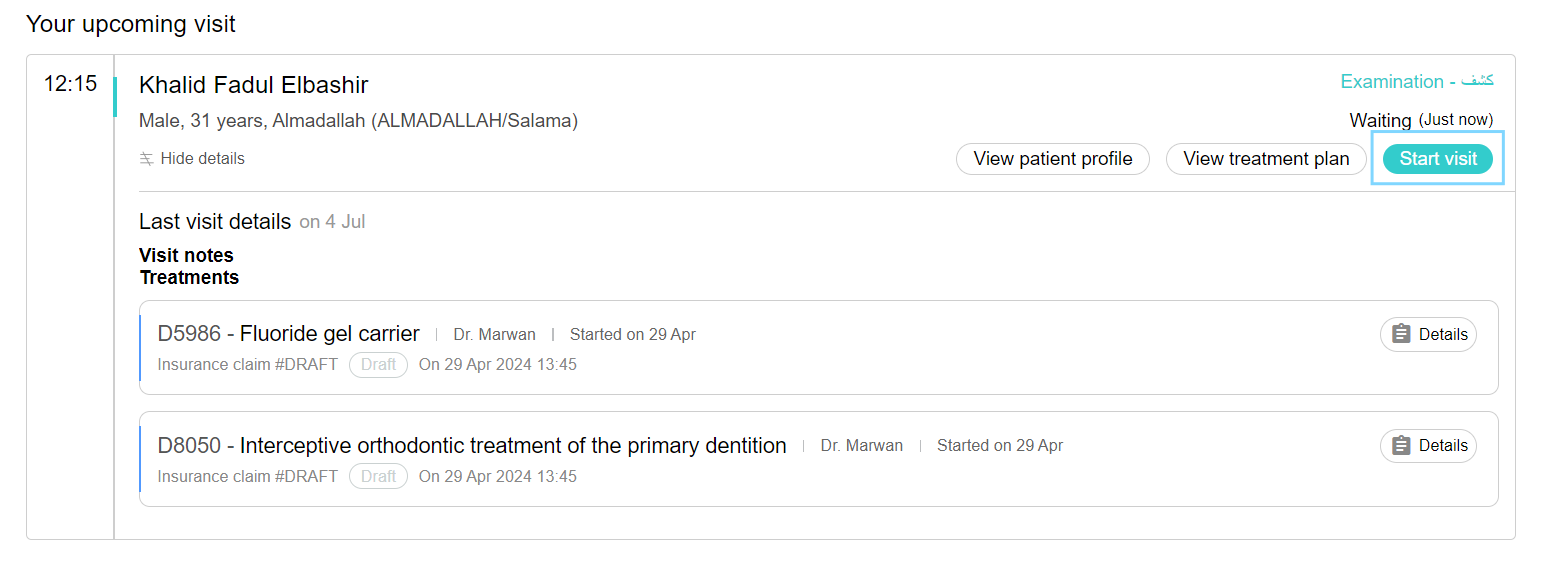
If you want to see all appointments for today and start your visits as a doctor, go to the planner tab. You will see on the left side your upcoming visit with the patient's name and details of your last visit and the subsequent visits. You can view the patient profile by clicking on the "View Patient Profile" button under the patient's name and start the visit by clicking the "Start Visit" button.
On the right side, you will see all of your appointments for today with their statuses.

What happens when you start the visit:
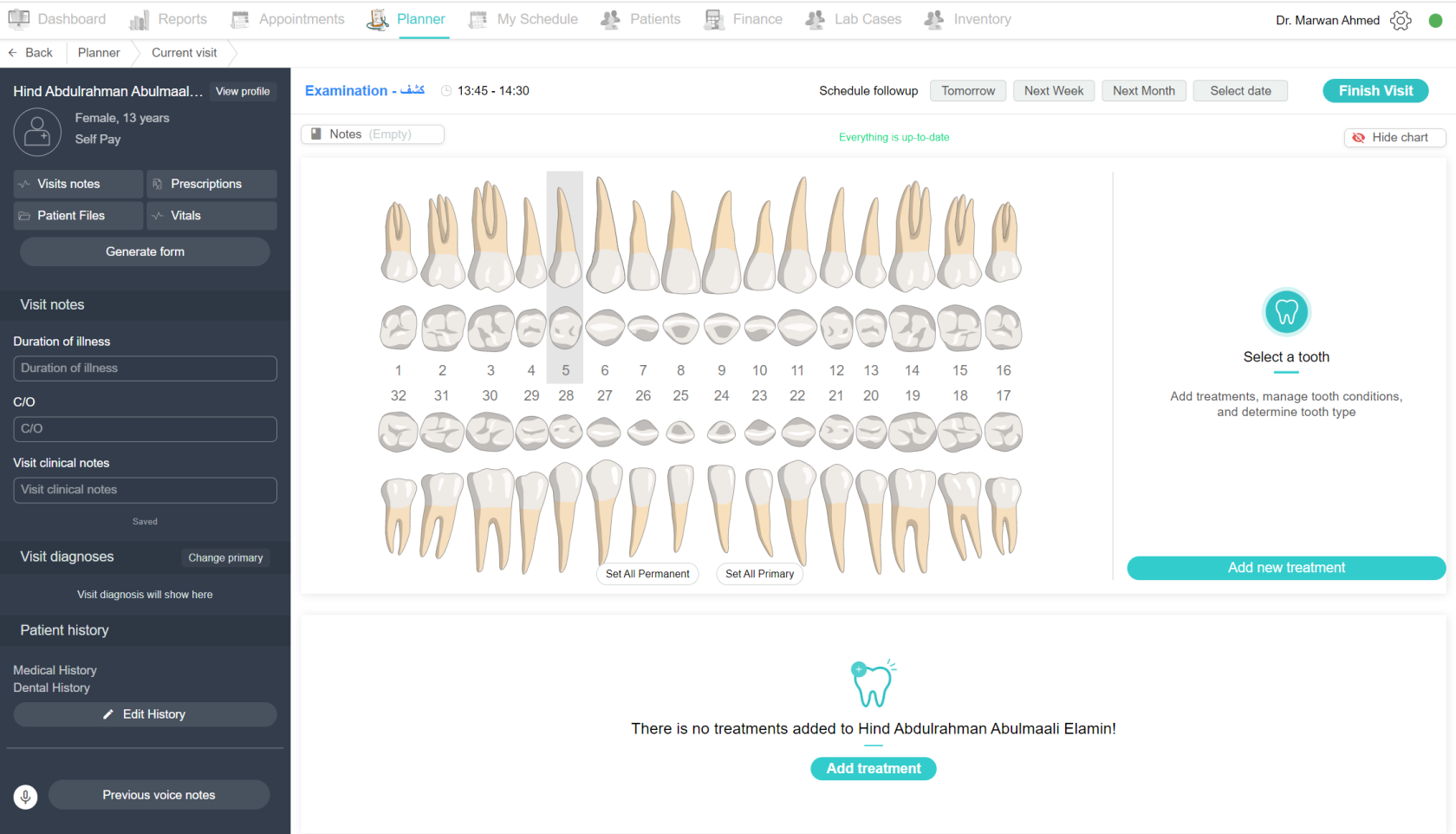
The “Current Visit” page opens, it consists of everything needed for the doctor on one page.
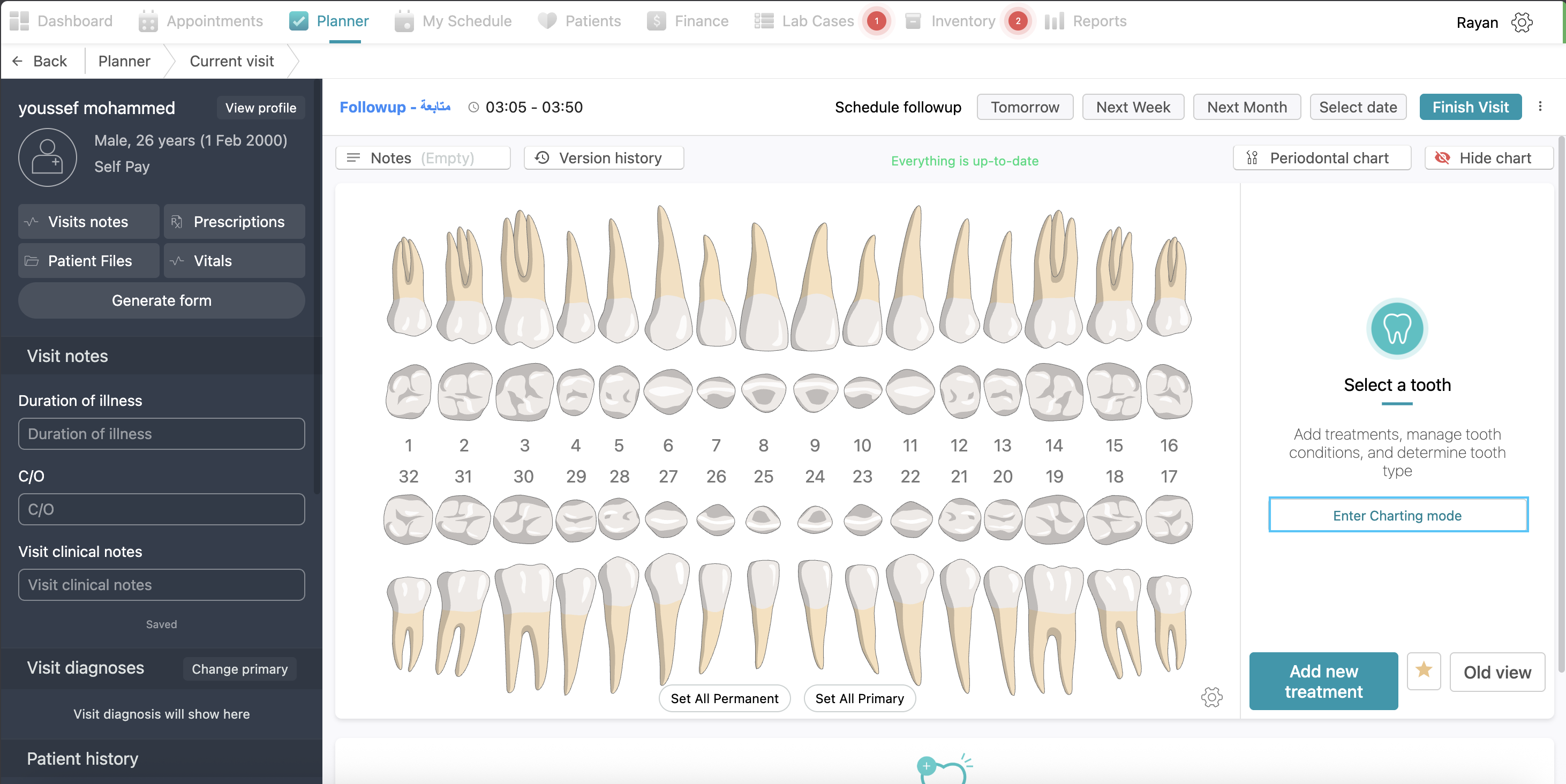
Using the Charting Mode
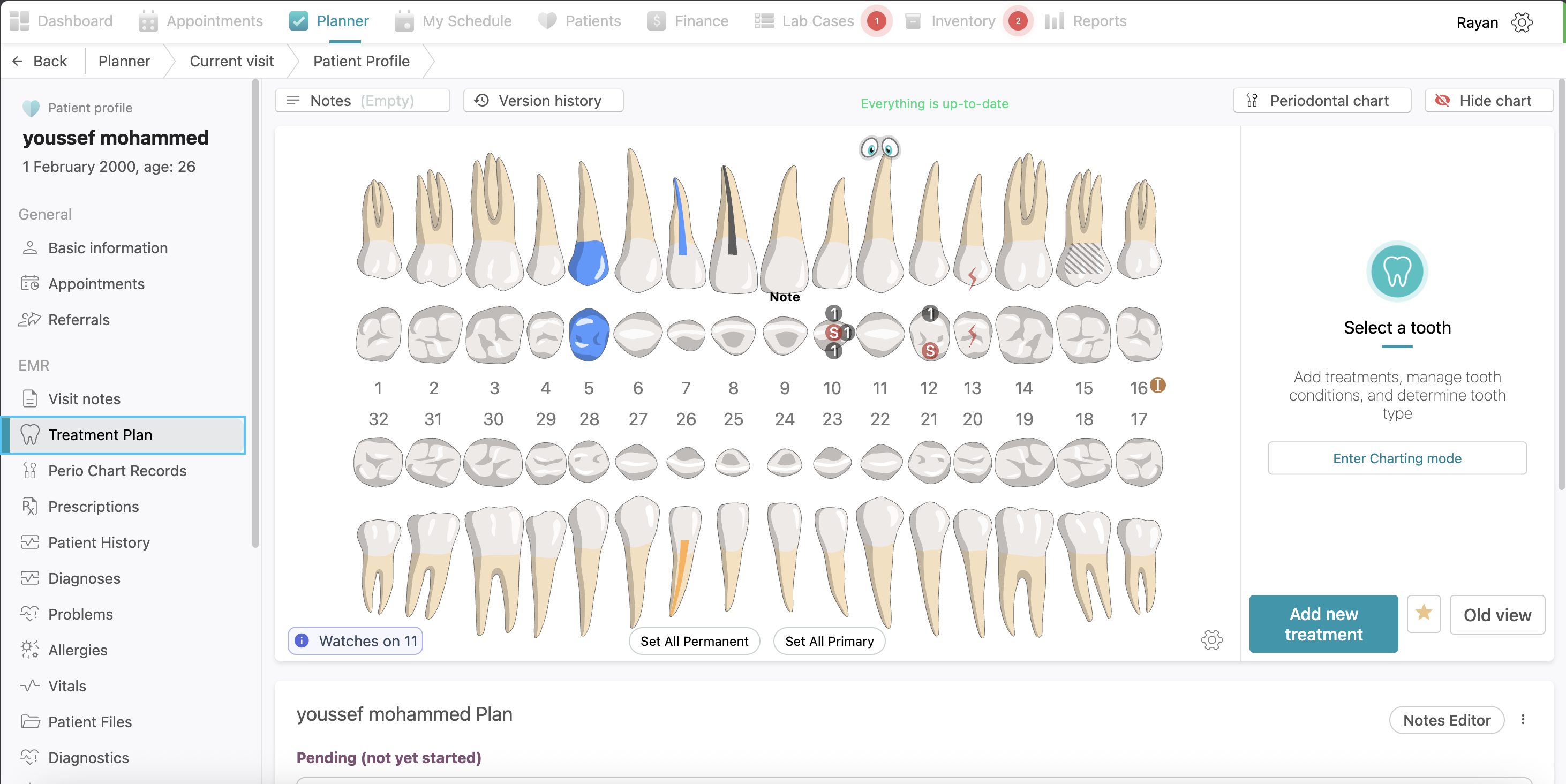
For doctors, the Charting Mode provides a clear visualization of the patient's dental status. To begin, click the "Enter Charting Mode" button; this provides a larger view of the dental chart. To get back to the original view, simply click the “Exit Charting Mode” button.
To adjust the dental chart based on the patient's age or specific dental needs, you can easily modify the tooth types within the charting mode. By default, the system displays the permanent teeth view.
If the patient is young for example, you can switch the entire chart to primary teeth by clicking the “Set All Primary” button located at the bottom of the page. To return to the default view, simply click the “Set All Permanent” button, and the chart will revert to permanent teeth.
In some cases you may want to adjust only a single tooth, for example if a patient has a primary tooth remaining in a permanent set. In this case, you can click on that specific tooth in the chart and a sidebar will appear on the right side of the page showing the tooth's current status. Next to the “Permanent” label, you will find the “Primary” option. Simply click on “Primary,” and that specific tooth will now be displayed as a primary tooth while the rest of the chart remains permanent. You can follow the same process to change a single primary tooth back to permanent.
Adding a Tooth Condition
To document a specific issue, select the tooth in the chart with a single click and a sidebar will appear on the right side. On the sidebar, under "Add tooth conditions," you can choose from the common options like Missing, Caries, Fracture, Pulpitis, or Lesion. Or you can click on “other” to find other options like Impacted, Cervical lesion, Add a watch (if selected, you will find eyes on the tooth to be watched) or you can add custom text for cases that aren’t commonly found and it will appear in the chart view.
For conditions like "Caries (Per Surface)," if selected, a pop-up appears showing the tooth surfaces (Facial/Buccal, Mesial, Distal, or Lingual). You can toggle the severity of the condition by clicking the surface: one click for level 1 (lowest) up to 4 clicks for level 4 (highest). Once the severity and surfaces are selected, click the “Add” button, and the condition will appear visually on the dental chart.
Note: for faster workflow, if multiple teeth have the same conditions you can simply select them from the chart by 1 click for each tooth (they will be highlighted in blue color) and add the condition instead of doing it separately for each one.
Adding and Managing Treatments
To add a treatment, click the selected tooth and choose the "Add treatments" button from the sidebar. A list of treatments will appear where you can search for or select the required treatment.
In the "Add treatment" pop-up (after selecting the treatment), you can include a Diagnosis by searching for the name or ICD code. To save time, you can click "Manage favorites" and use the star icon to add your most-used diagnoses to a quick-access list. (visualization: video)
Before finishing, set the treatment Status:
-
Pending: The doctor didn’t decide whether to do this treatment or not.
-
Current: The treatment is currently being performed (indicated by a blue color on the chart).
-
Recommended: Suggested for a future visit. (indicated by an orange color on the chart)
-
Existing: The patient has already received this treatment elsewhere before. (indicated by a black color on the chart)
Click "Add and Start Treatment" to save. You can view all treatments and their statuses in the list below the chart.
Progress Notes and Finishing the Visit
After adding all treatments you will find them in a list below the chart.
To record specific details of a treatment, click "Details" next to the treatment to add diagnosis and Progress Notes. Note that progress notes are required and can only be edited or deleted while the treatment is in the "Current" status. Once you have added your notes, click "Save Treatment". (visualization: video)
To update a treatment status to "Completed," click the status button in the list; once completed, the tooth color on the chart will change to green.
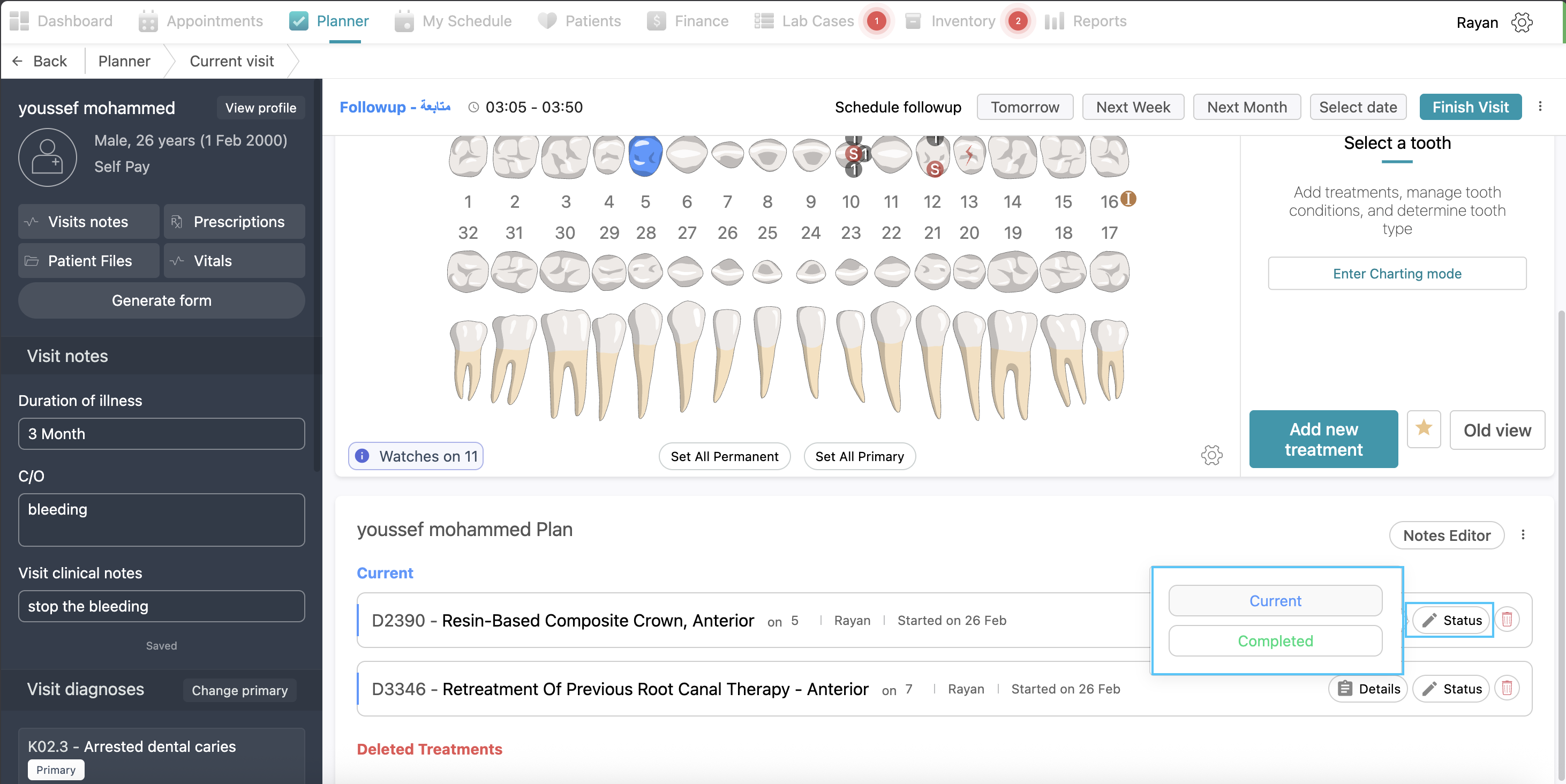
When the session is over, click the "Finish" button at the top right. If patient allergies are missing, the system will prompt you to add them before finalizing. Once finished, the visit is locked and treatments cannot be edited.
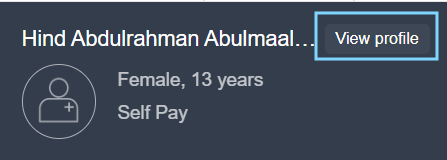
- On the left side, you can see the patient information. If you want to see the patient profile, click on the "View Profile" button.
Patient Profile
In the patient profile you can see all the basic information of the patient and many other things.
Notes and Alerts (visualization: screenshots)
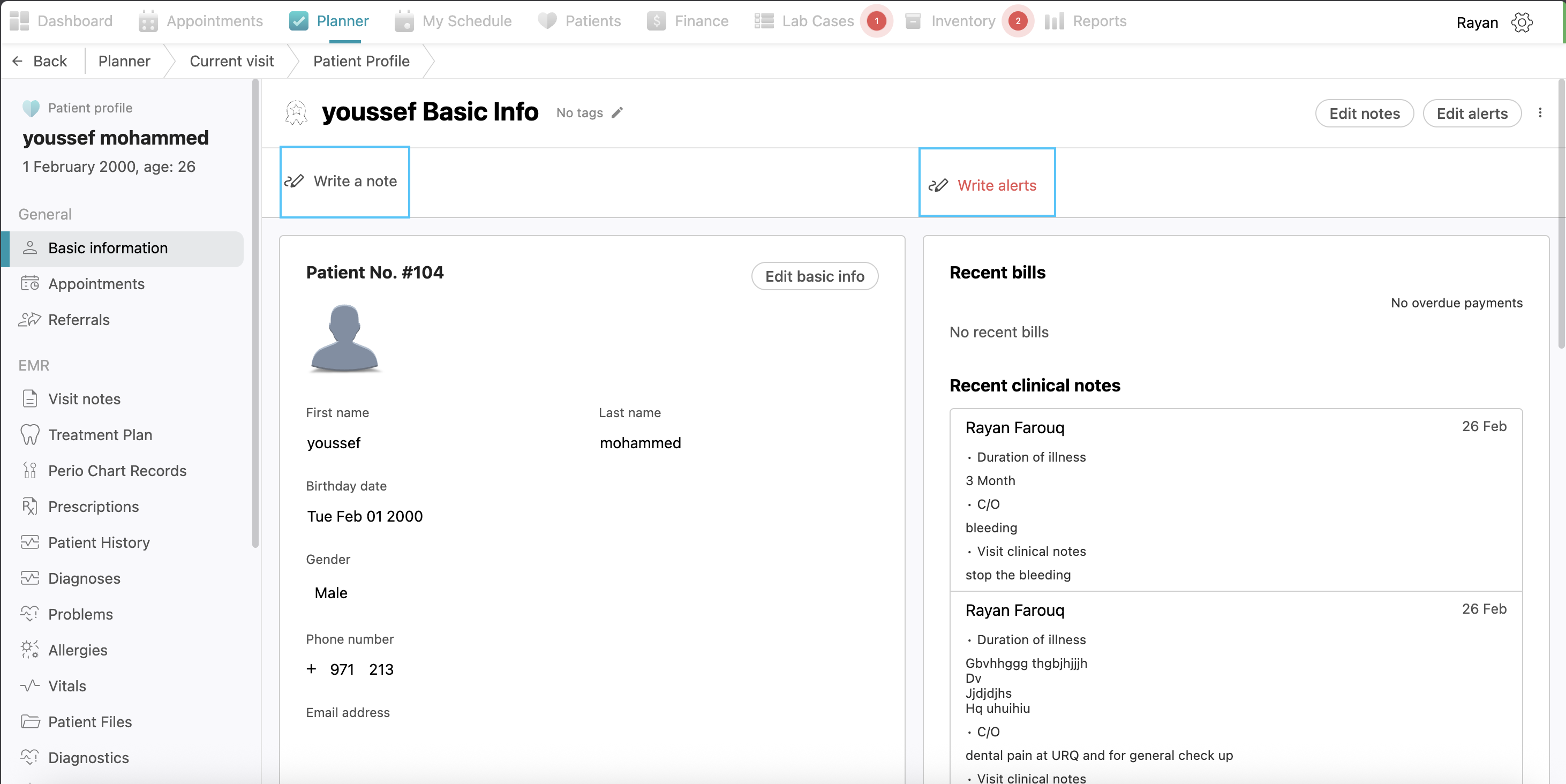
After clicking the “View profile” button, you will be navigated to the basic information of the patient. And at the top of the page you will see two options: “Write a note” and “Write alerts". To record general information, click the “Write a note” button to open a digital notebook where you can add multiple personal notes regarding the patient. If there is a critical condition or specific concern that needs to be highlighted, such as "ADHD," click the “Write alerts” button. Alerts are similar to notes but appear prominently in red color in the appointments view to ensure they are well taken care of. After entering the required information in either section, click the “Save” button to store your changes. If you need to modify existing information later, you can click the “Edit notes” or “Edit alerts” buttons to update the content.
Basic information
This section displays the patient's basic data like file number, name, Emirates ID,…etc.
Appointments
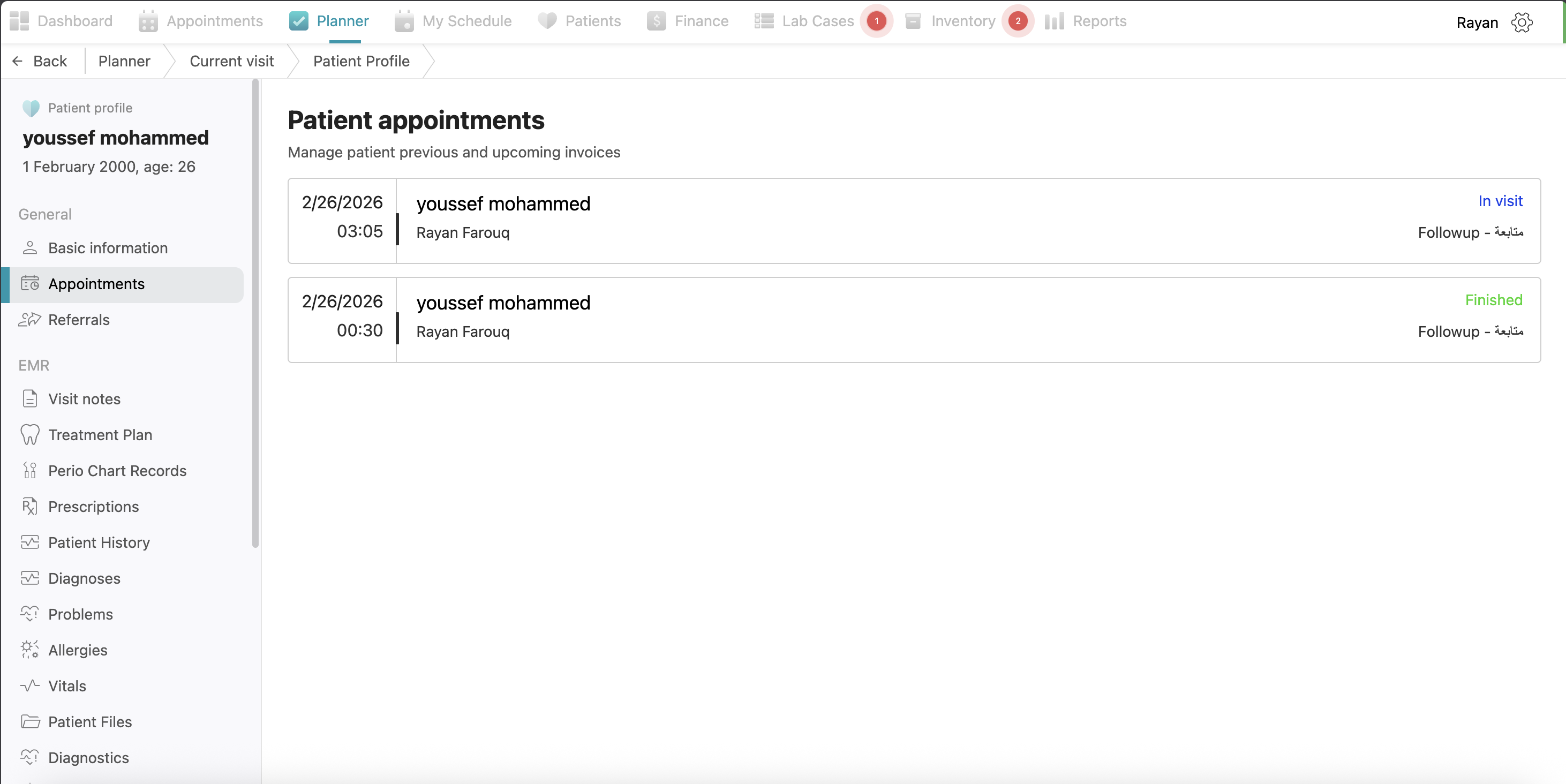
This tab allows you to view all previous and upcoming appointments for the patient.
Referrals:
If the patient requires care from another specialist, you can use the "+ Patient Referral" button to document and track the referral. Click “+patient referral” button. Then you can select the referral type (internal or external) and the doctor who is the patient will be referred to. Then you choose the referral reasons from a list or custom written. Then you select the tooth number and you can write notes if you want. Then click save and the referral will be sent. Note: the referral type, referred from who and referred to are required and not optional. (visualization: video)
Clinical Documentation (EMR Data)
-
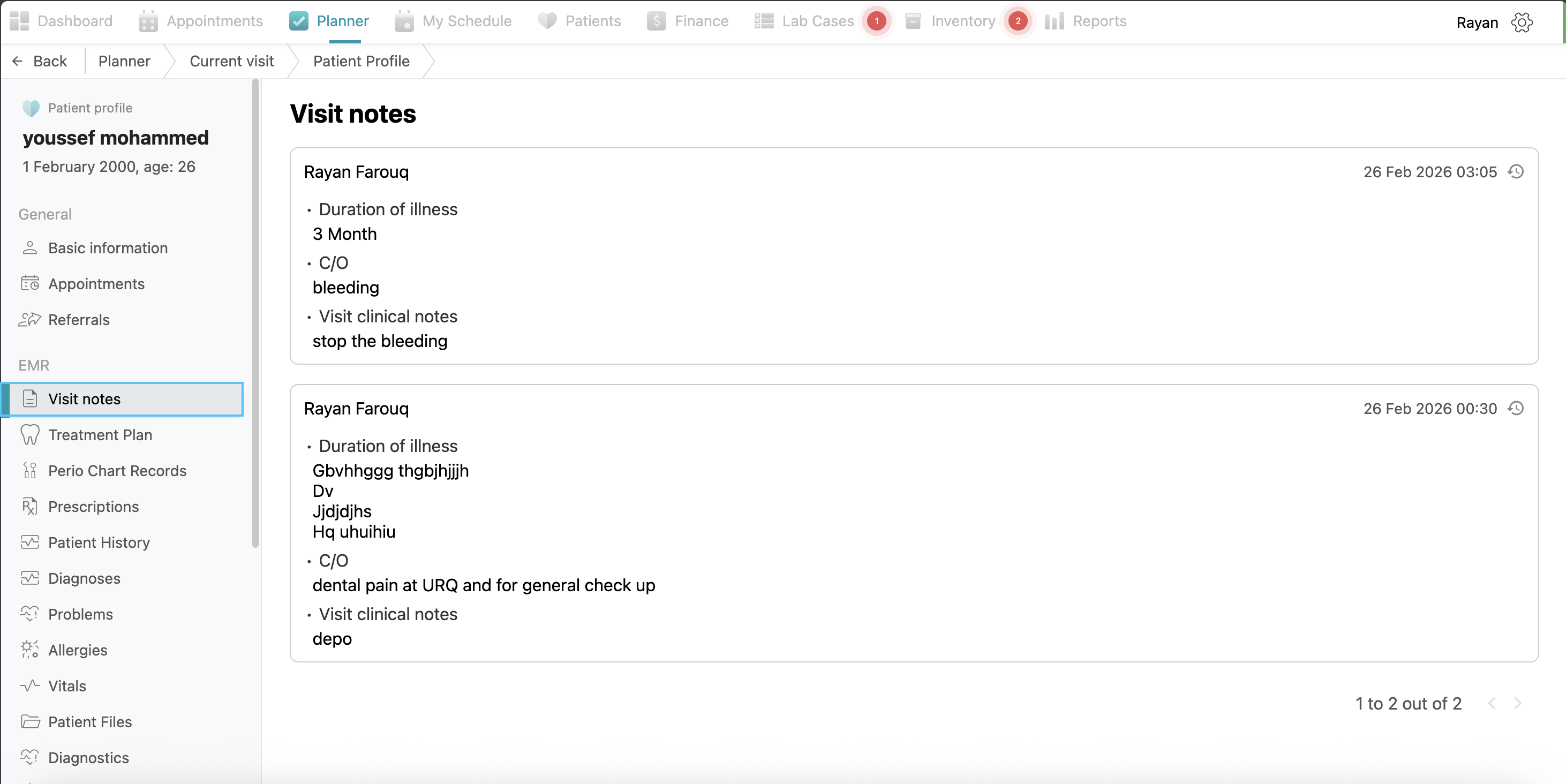
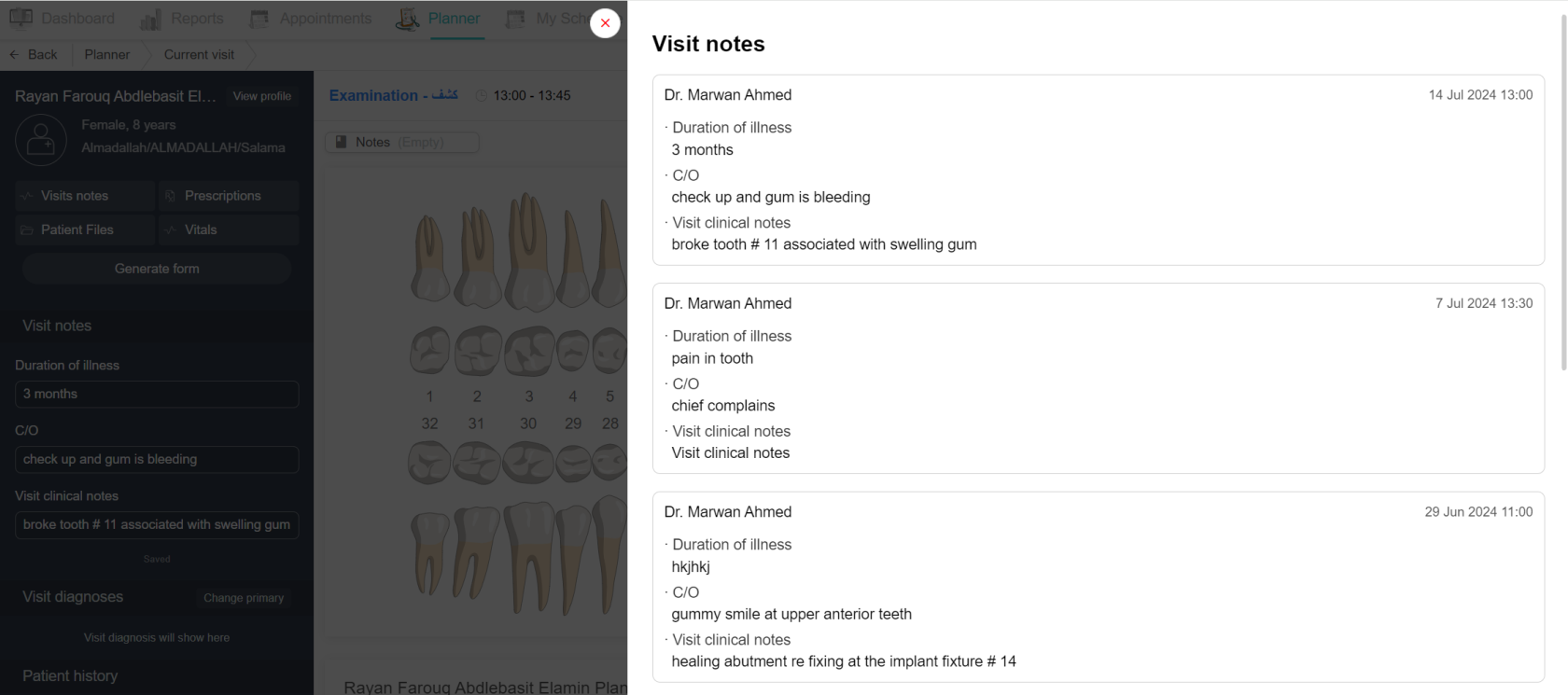
Visit Notes: This section stores historical clinical data, including the duration of the patient's illness and specific clinical notes from previous visits.
(visualization: screenshot)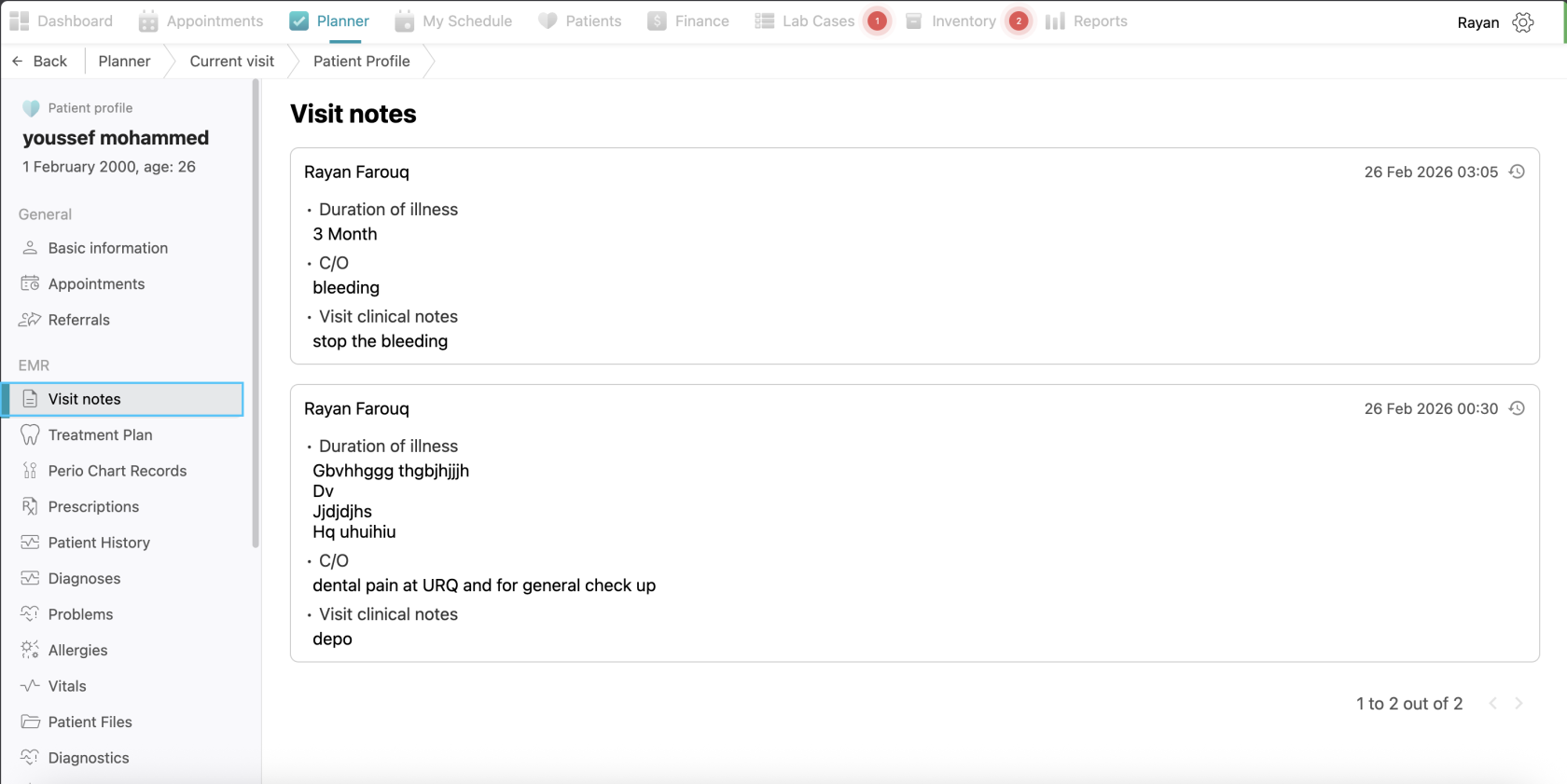
-
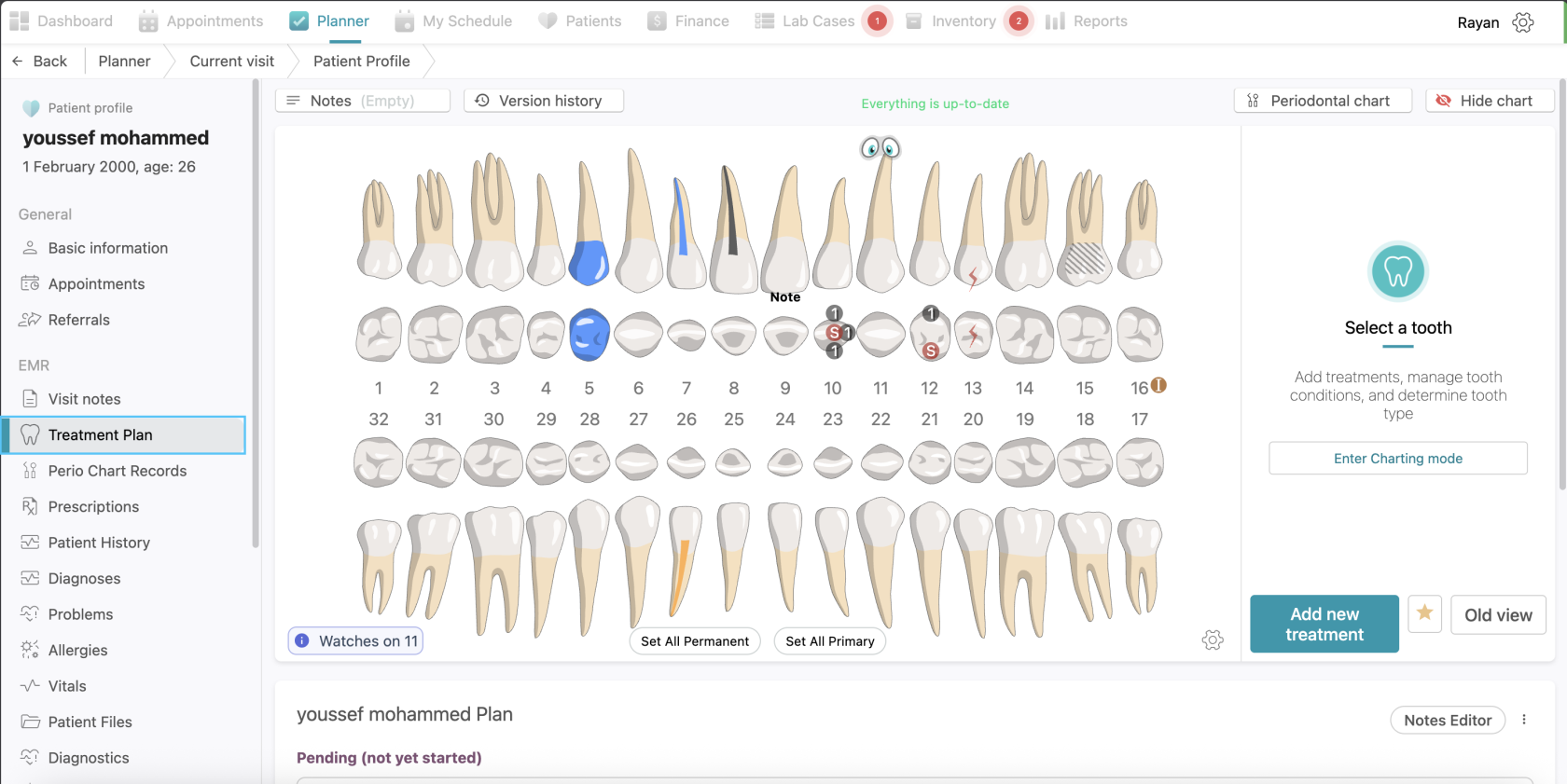
Treatment Plan: This view provides the full dental chart where you can track the status of all treatments whether they are current, completed, recommended, or deleted.
-
Perio Chart Records: This tab displays detailed periodontal chart records for gum and bone health.
-
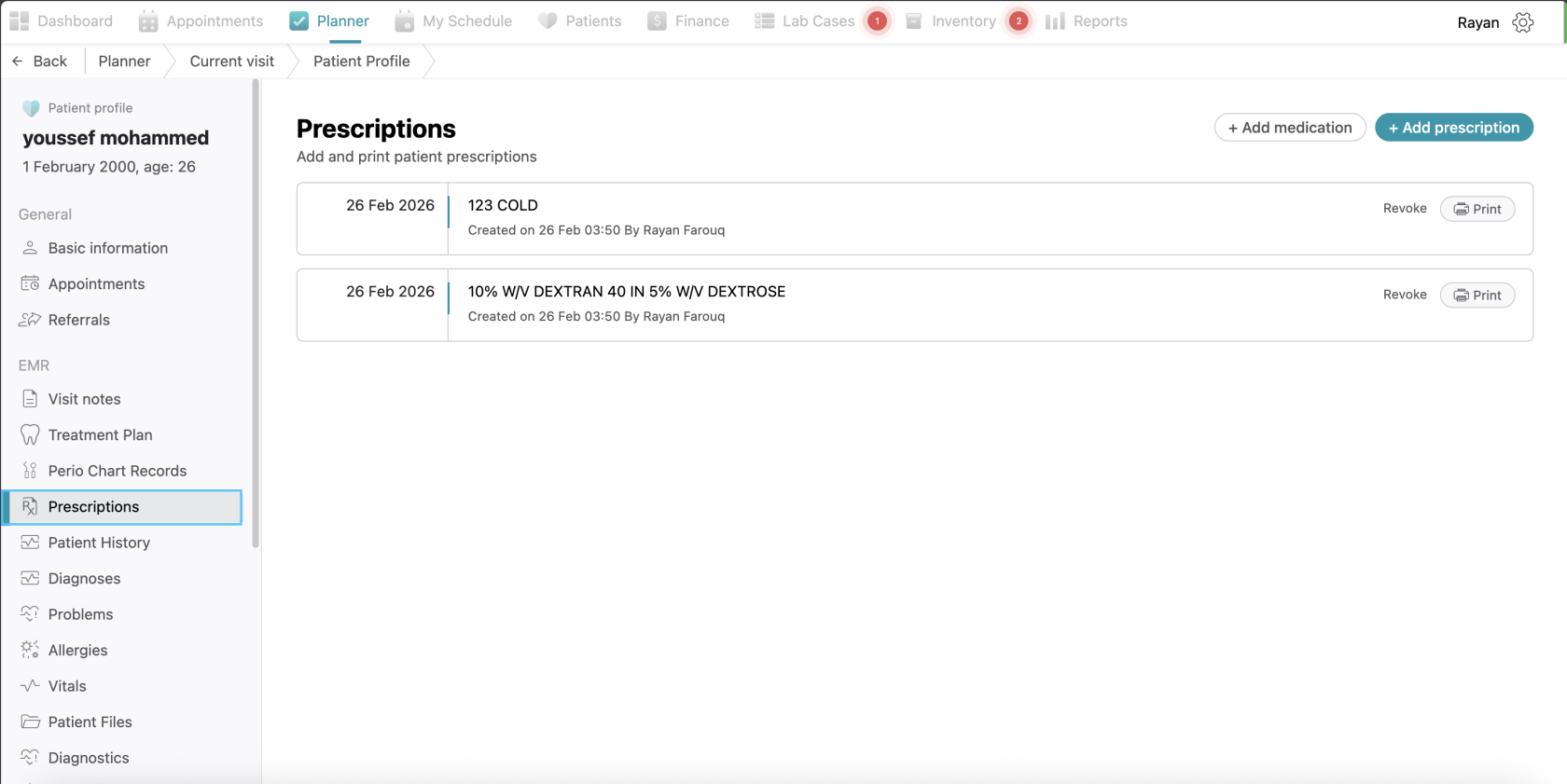
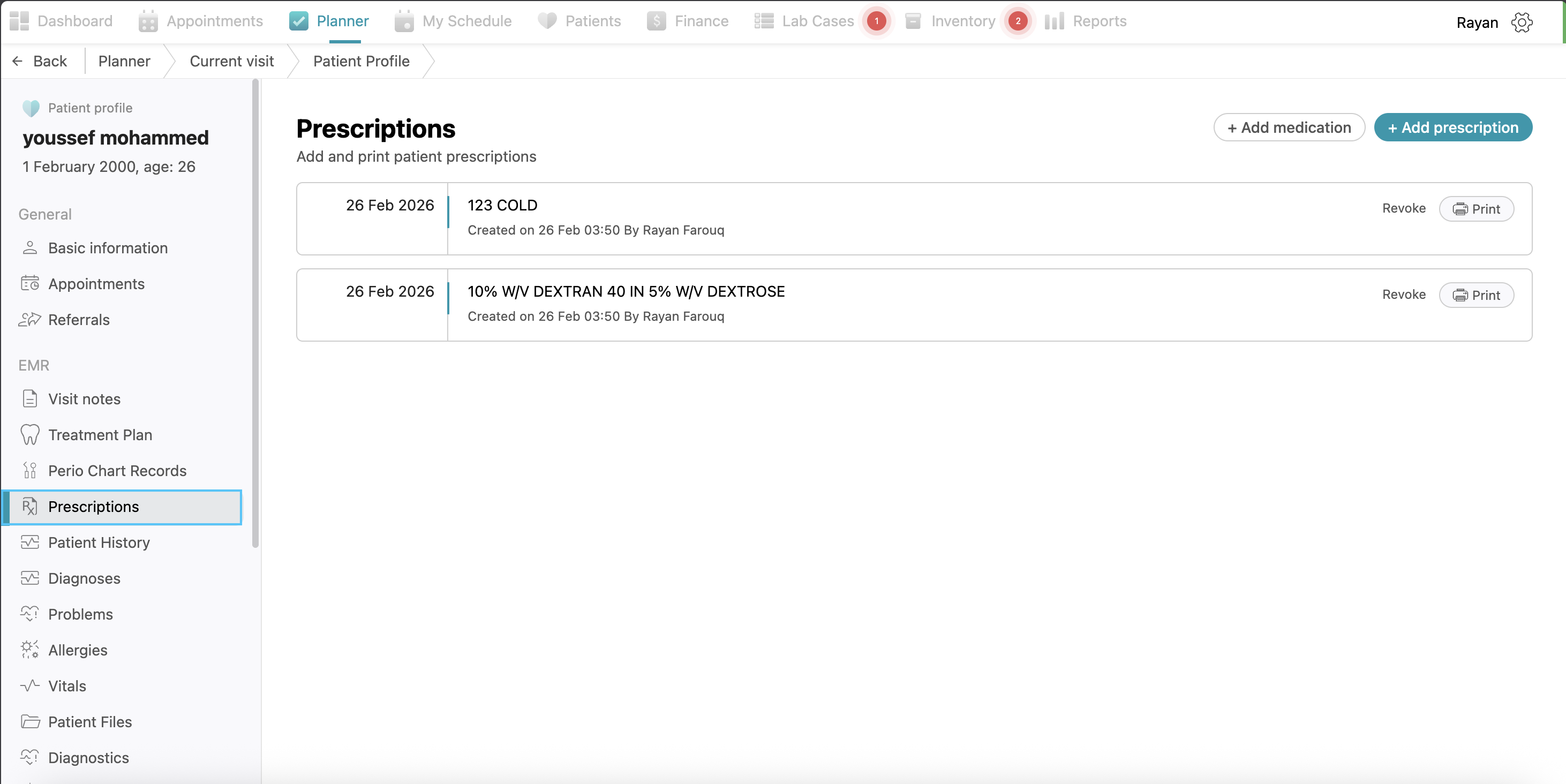
Prescriptions: This tab lists all medications prescribed to the patient, showing the date, the medication name, and the prescribing doctor. You can add prescriptions here the same way as explained before.
-
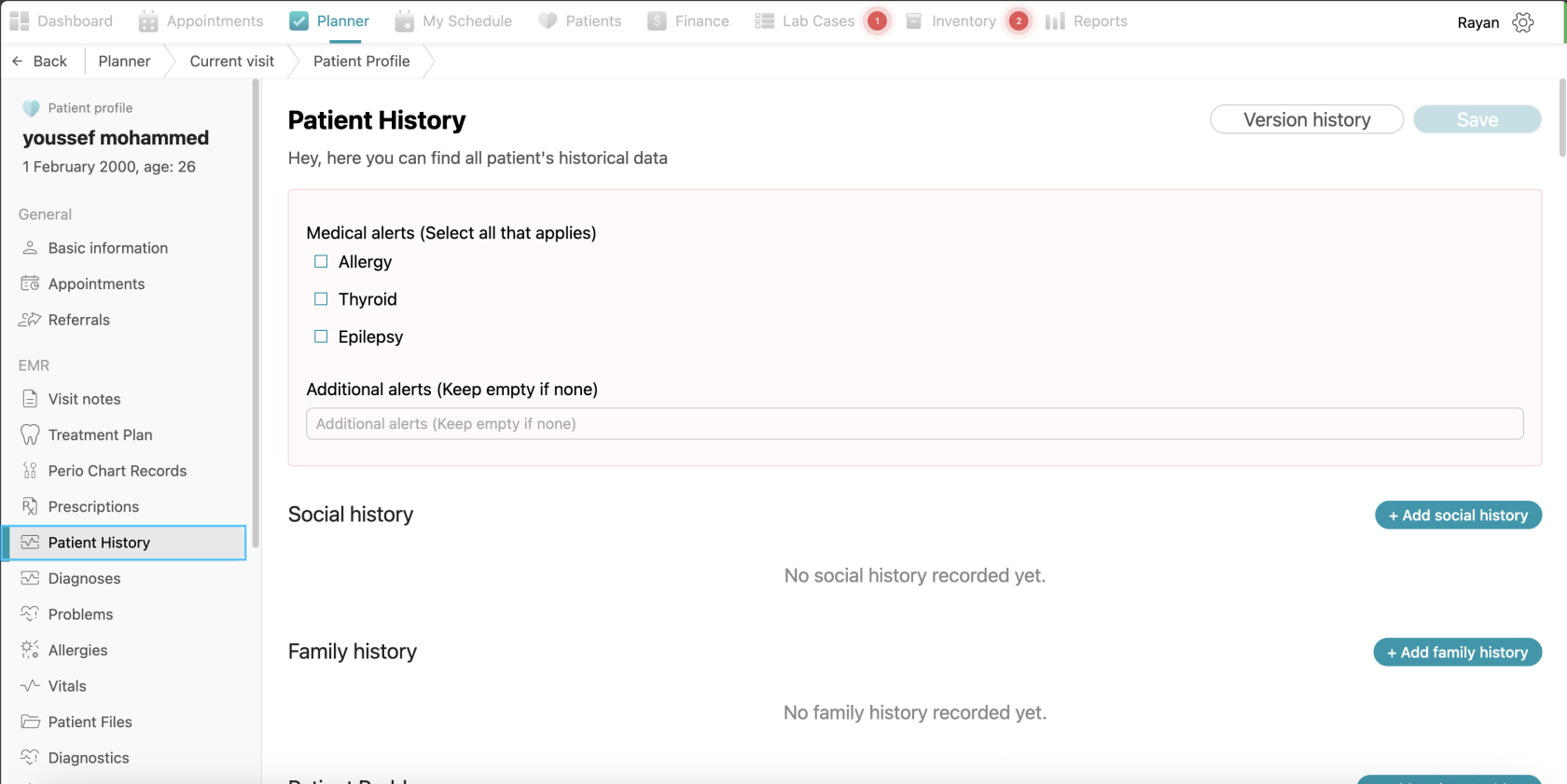
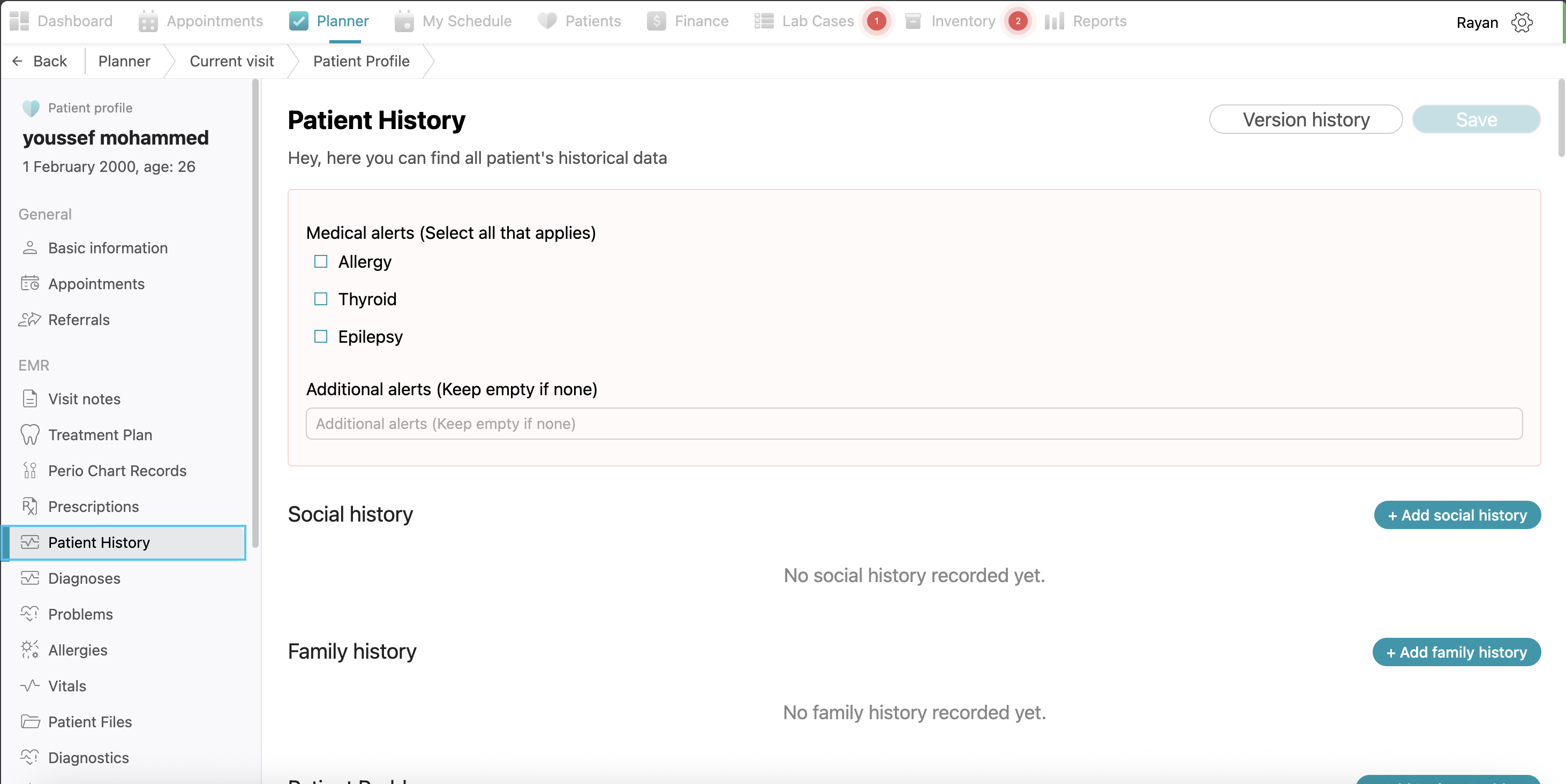
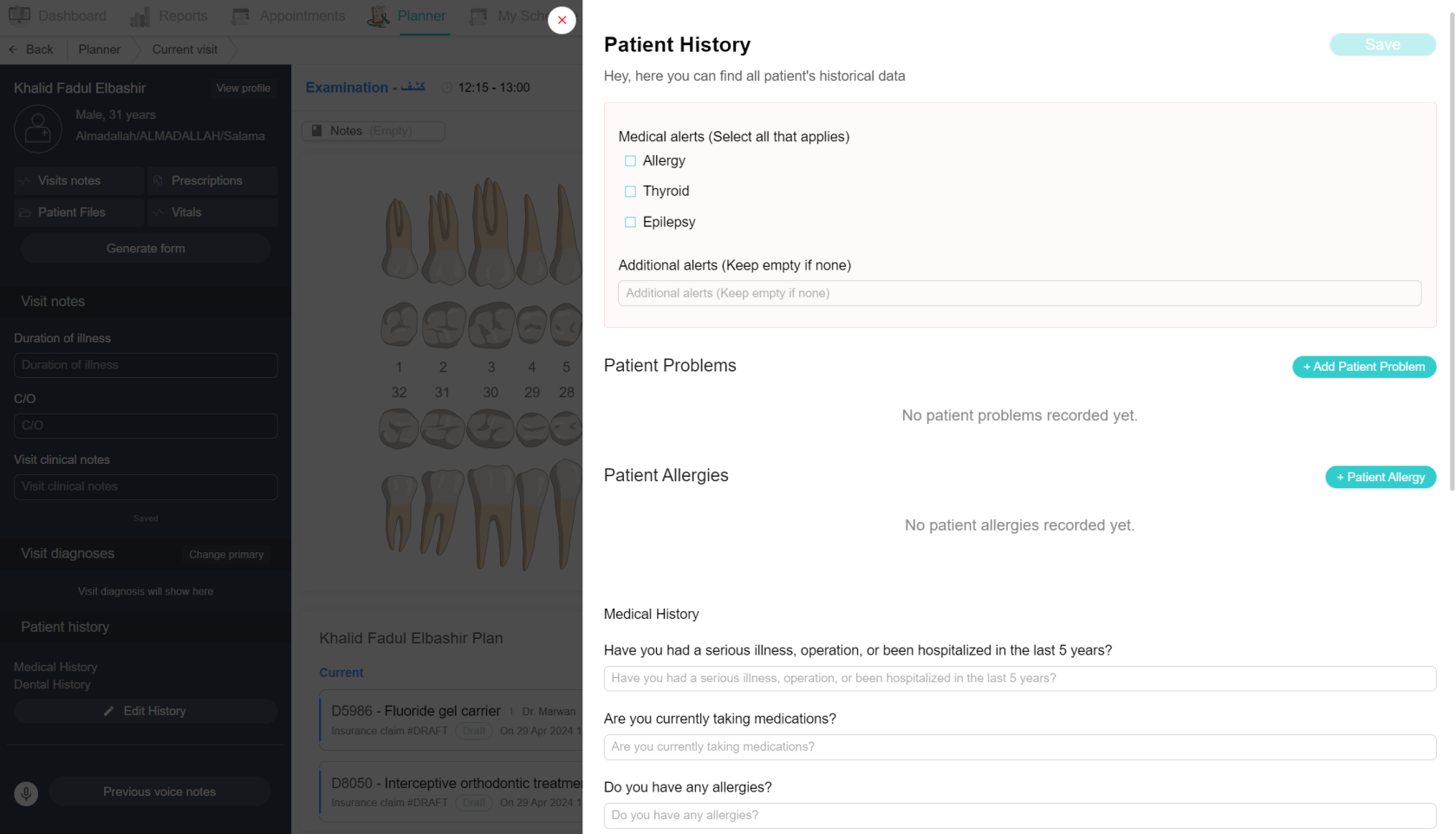
Patient History: A comprehensive area to view medical alerts (like allergies or epilepsy), social history, family history, medical history and dental history. and established patient problems. You can add more details here the same way as explained before.
-
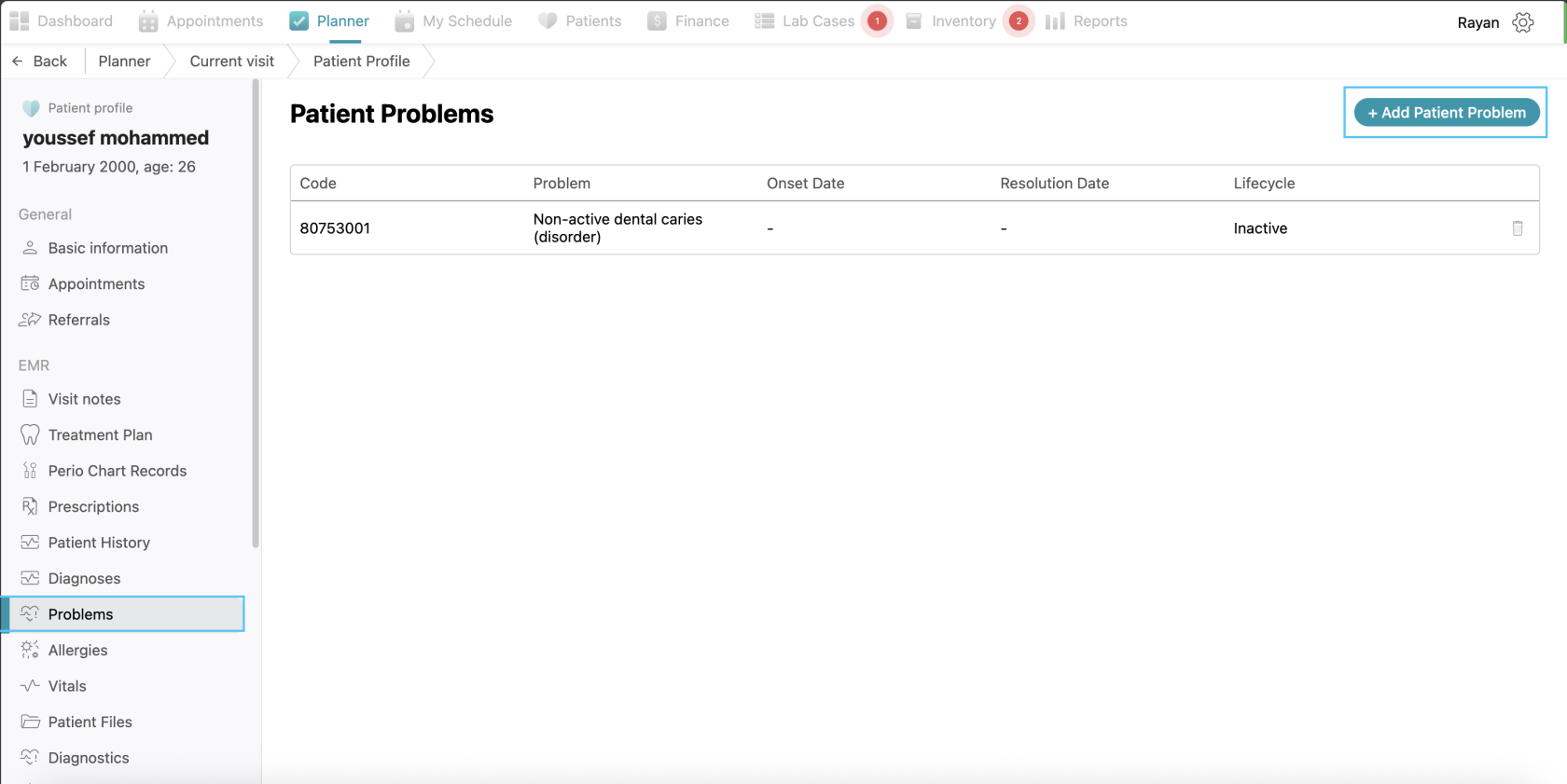
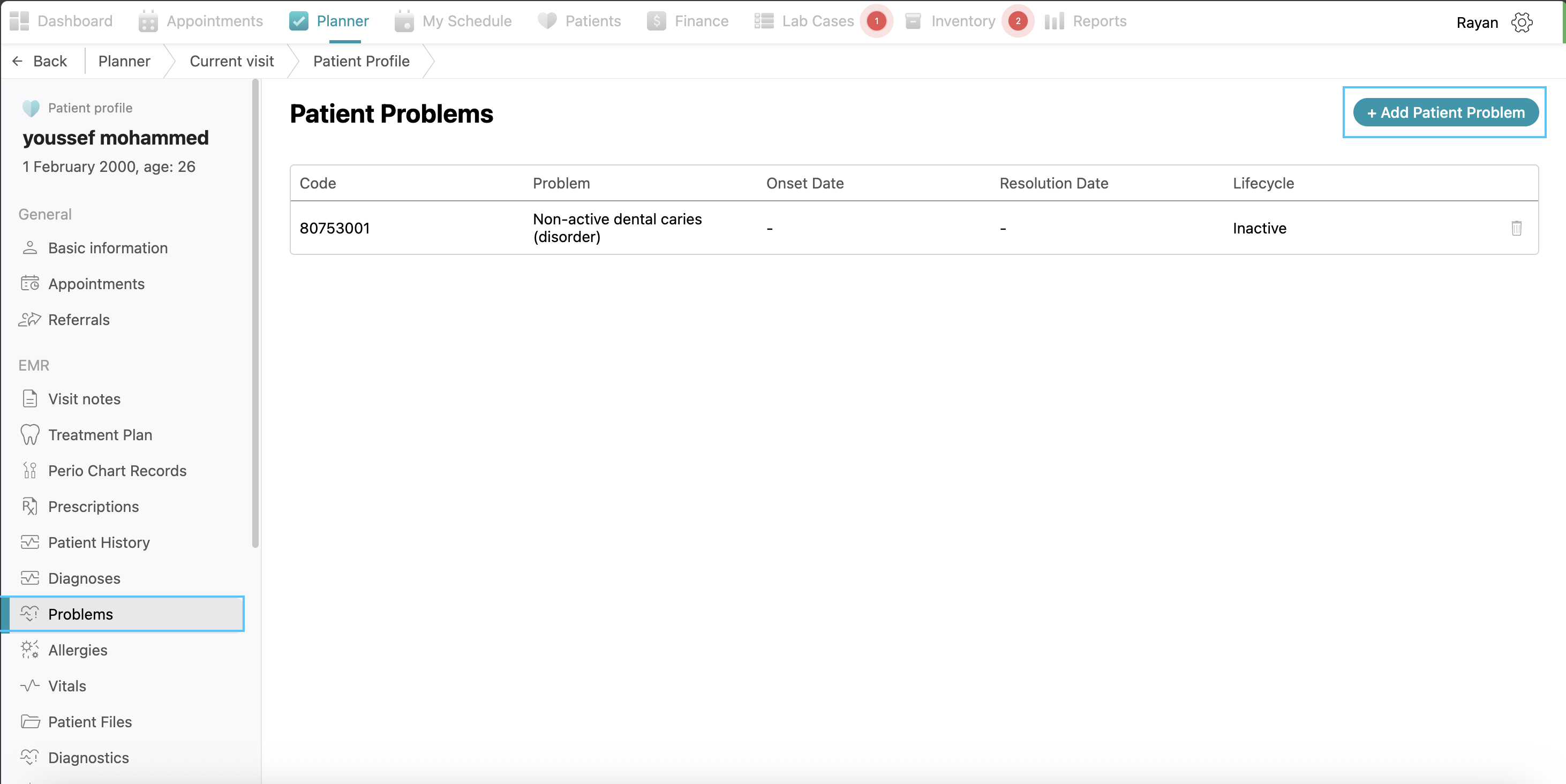
Patient Problems / Diagnoses: Click "+ Add Patient Problem" to document a diagnosis, its lifecycle (active/inactive), and the onset and resolution dates.
-
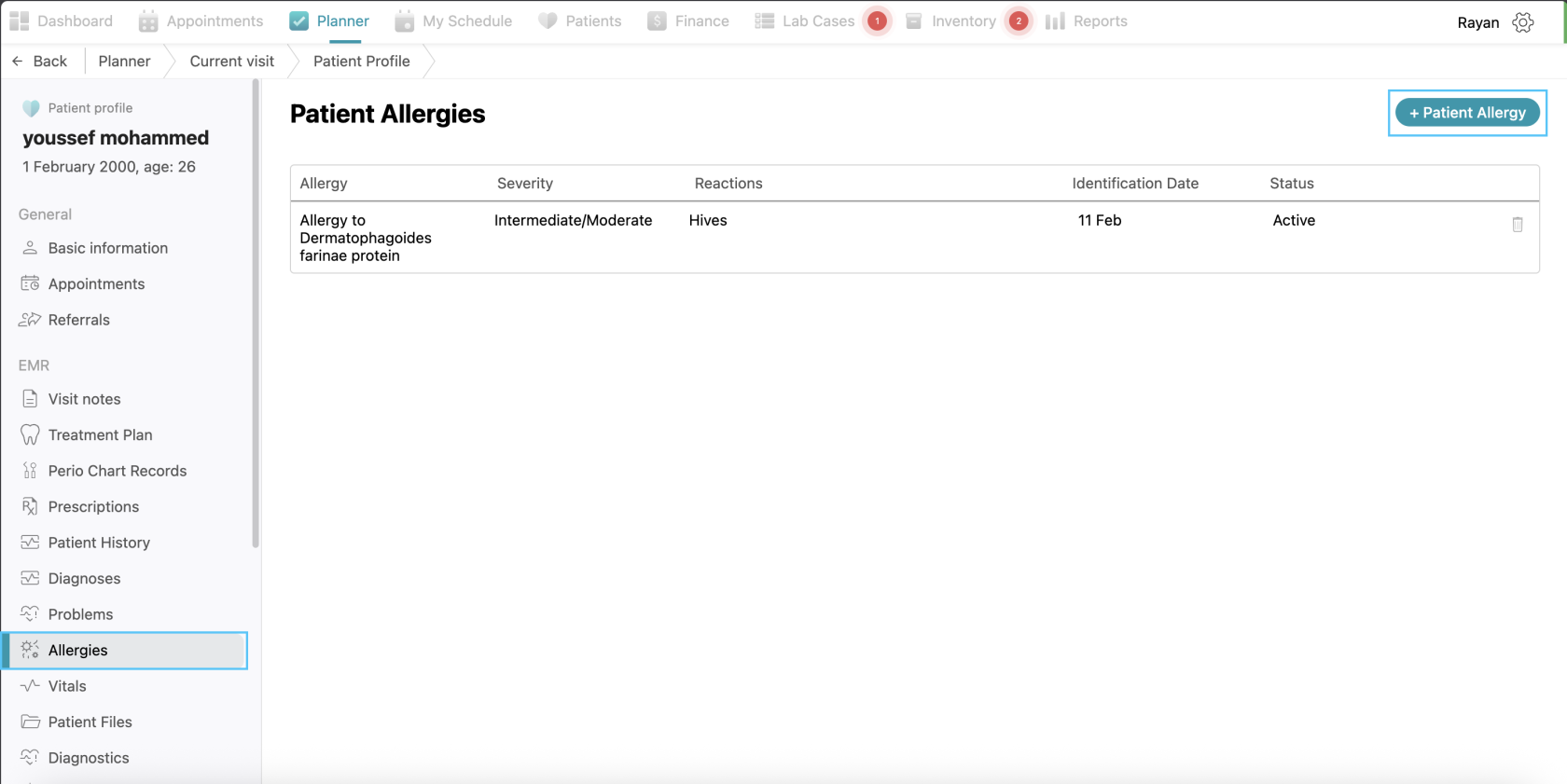
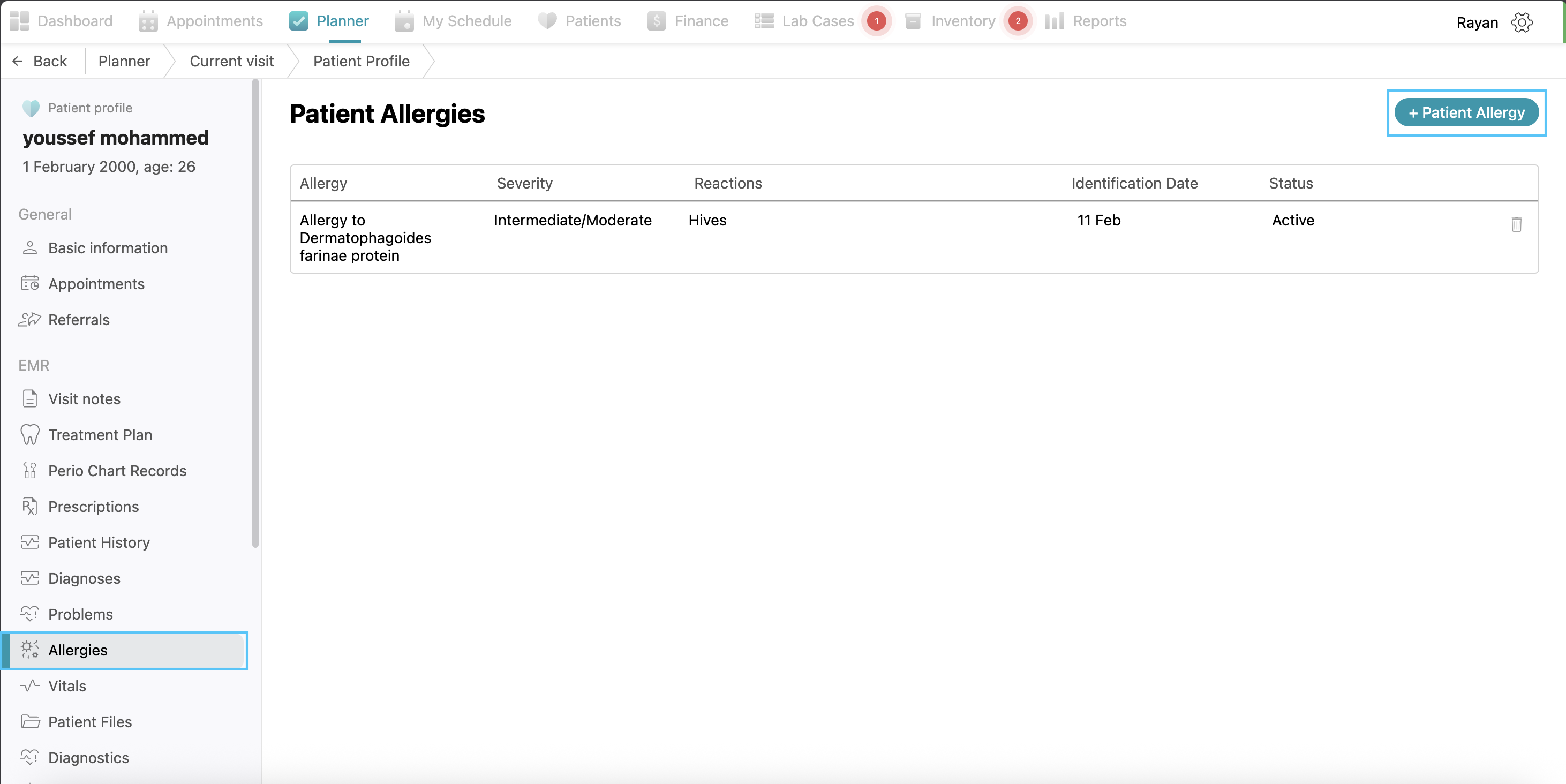
Allergies: you can view and add patient allergies by clicking the “ + patient allergy” button. Then selecting the allergy type (mandatory), allergy (mandatory). Severity, reactions, identification date and clicking save.
-
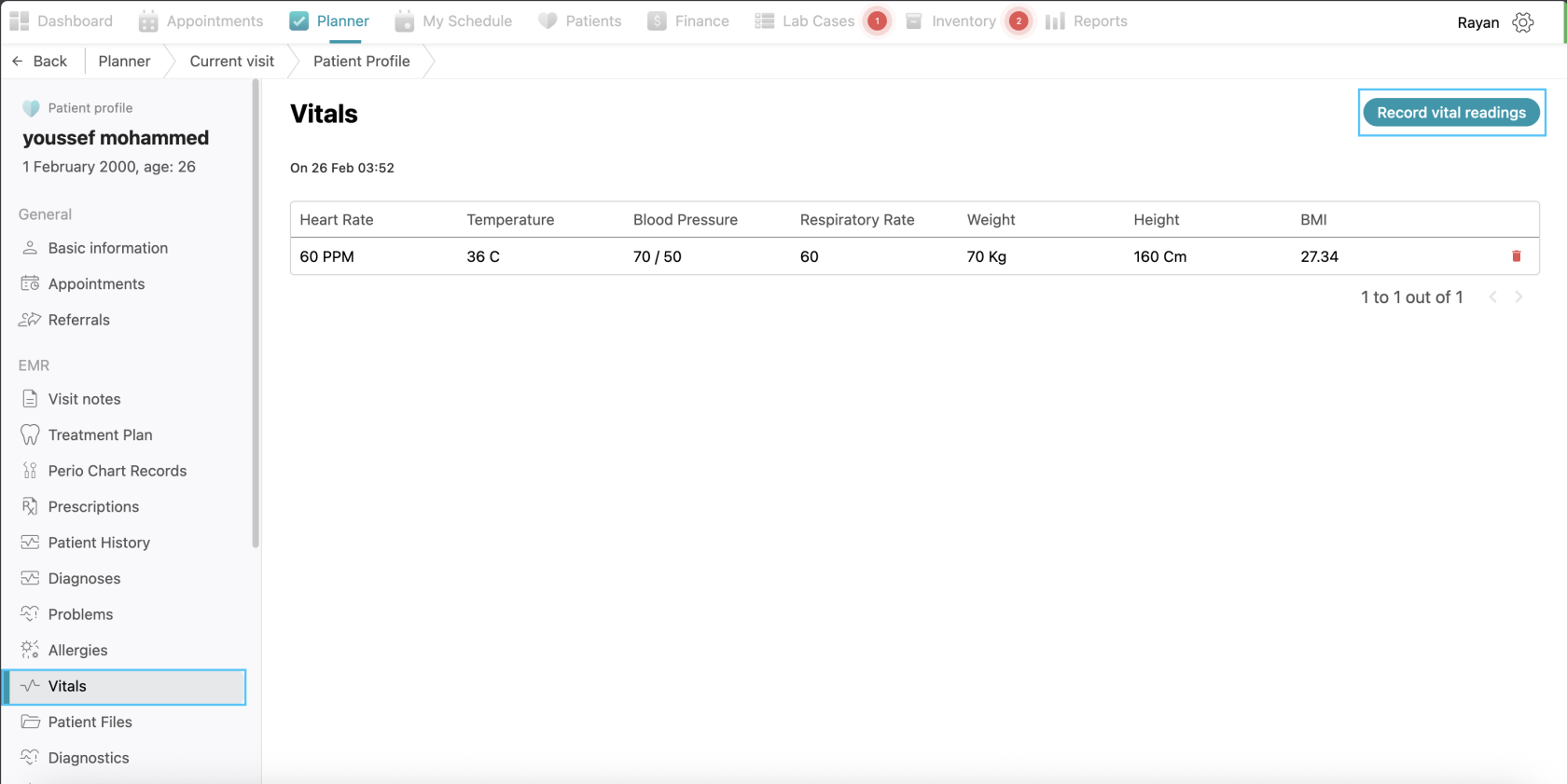
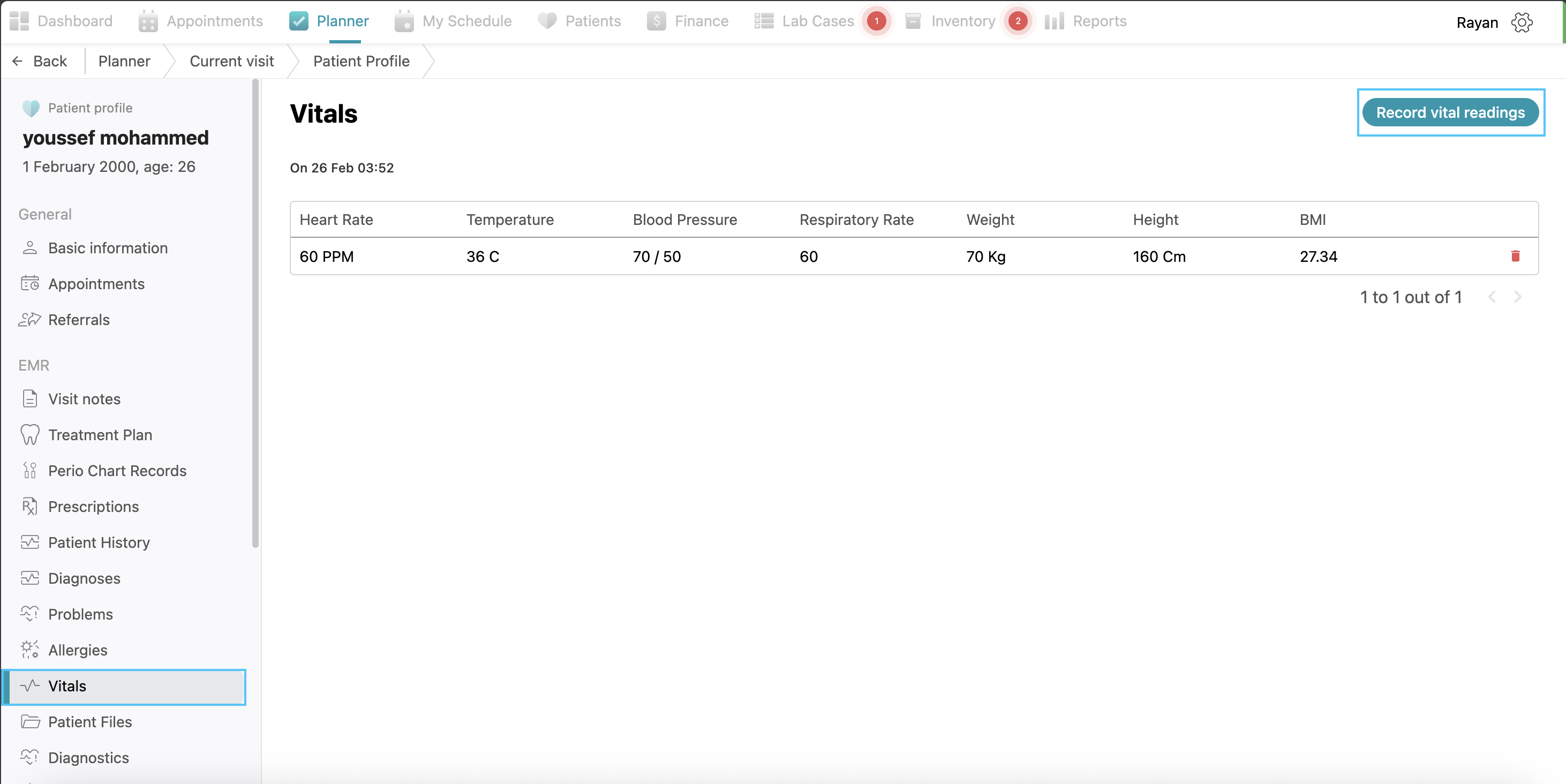
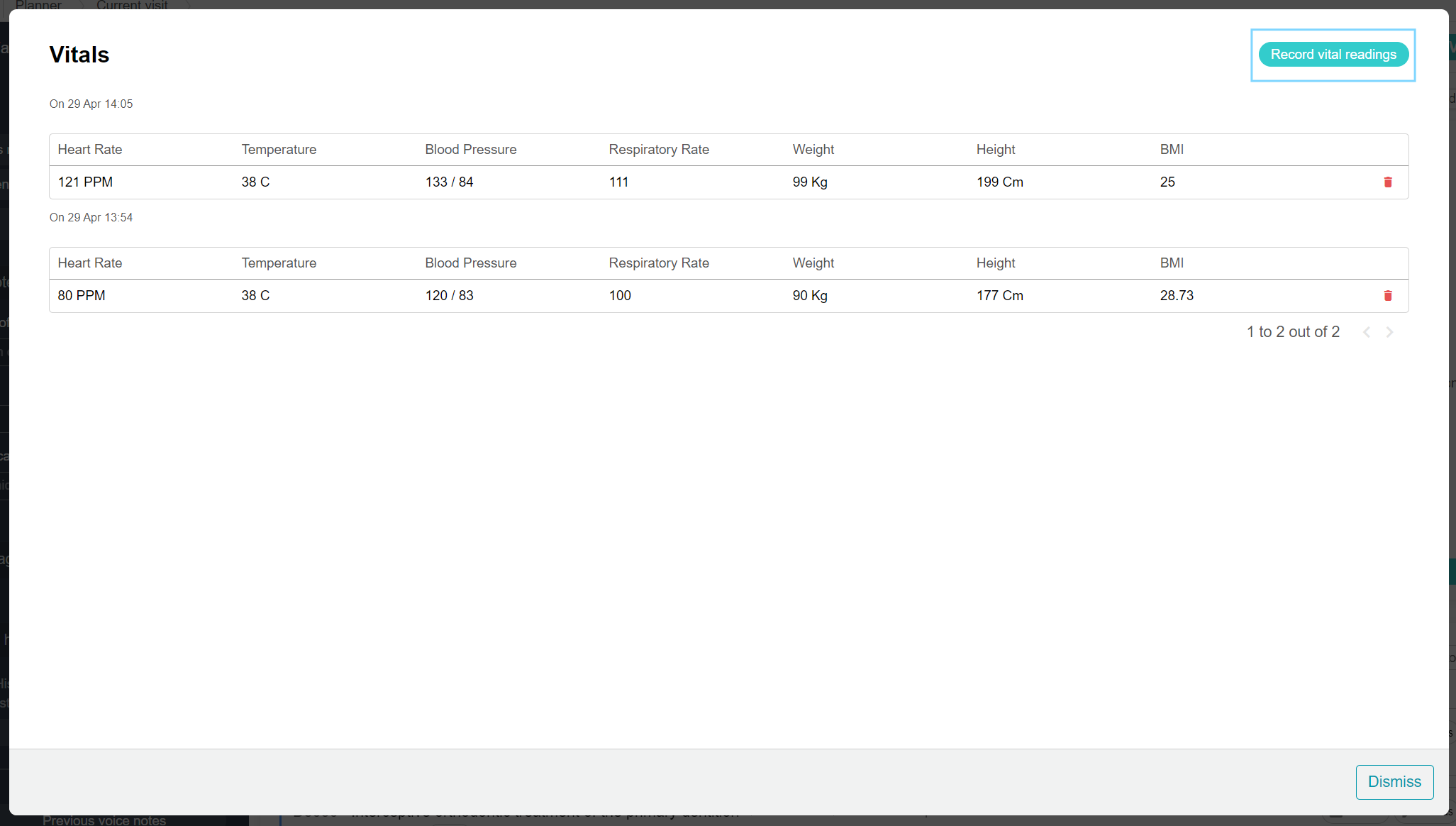
Vitals: you can view the patient’s vitals and add vitals through the “record vital reading” button.
-
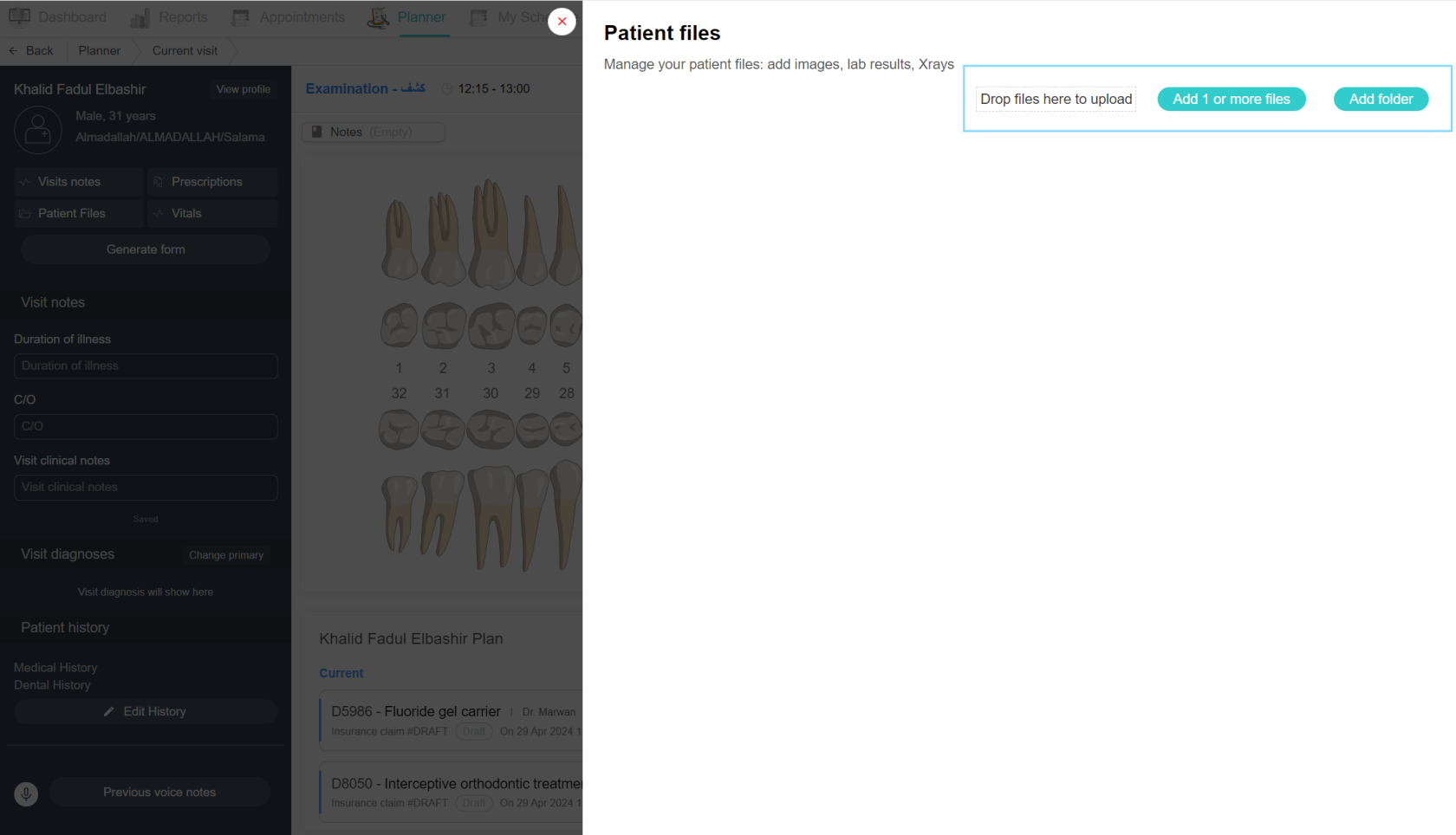
Patient Files: This section is used to upload and store external visualizations, such as X-rays, images, and laboratory results. You can view and add patients files. If you want to add a file to this patient, such as an x-ray or before and after images or lab results, click on "Patient Files". Click on "Add More Files" or "Add Folder" and select the file you want to add and upload it. You can see all of the files added to this patient at any time in this view.
-
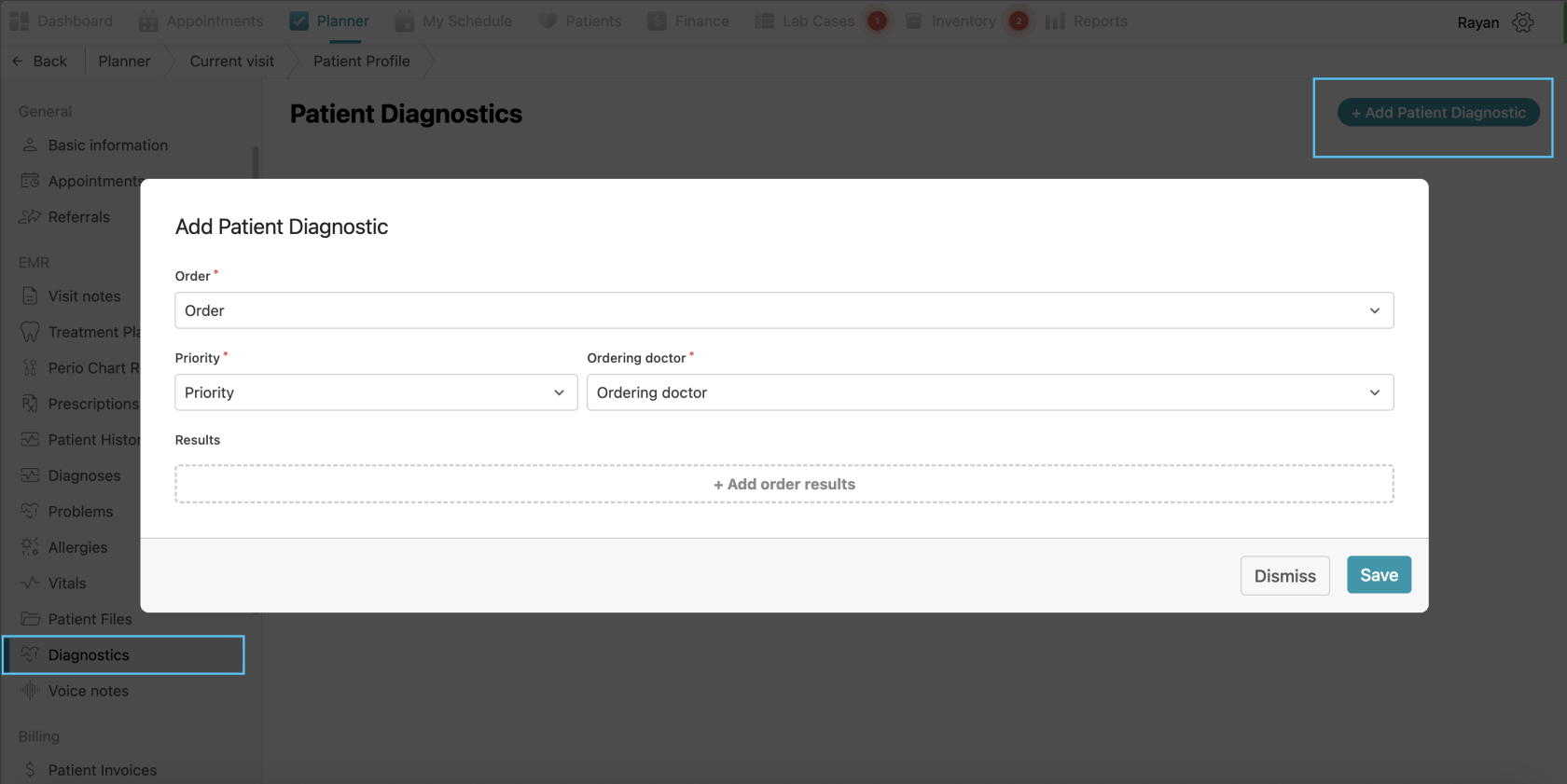
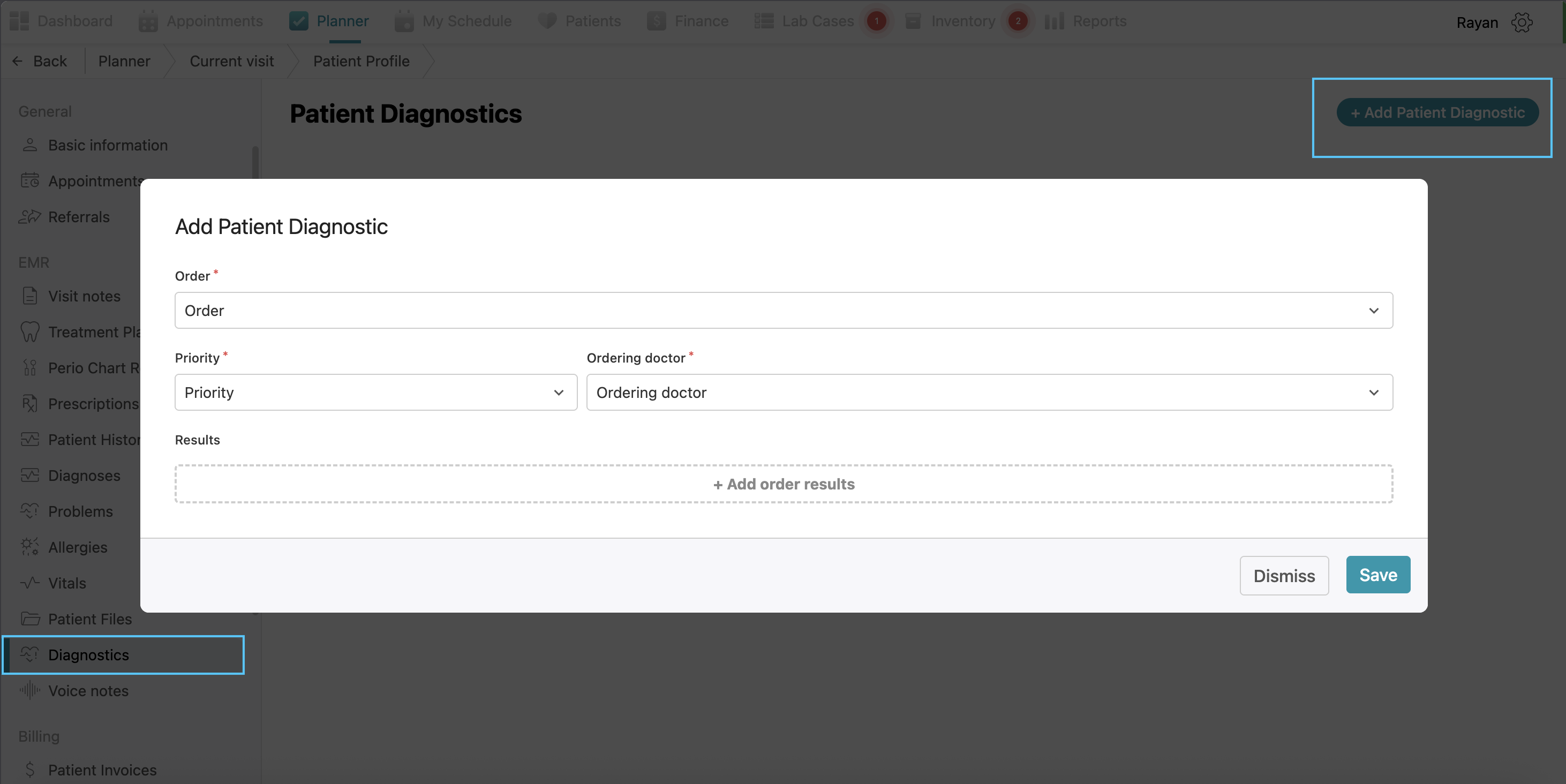
Diagnostics: Use this to order specific diagnostic tests and record the results directly in the patient's file. If you want to add diagnostics, click the “+add patient diagnostic” then select the order, priority, ordering doctor which are all mandatory, and then you can add order results by clicking the “+add order results” then selecting the result type (mandatory) and abnormal flag and clicking confirm.
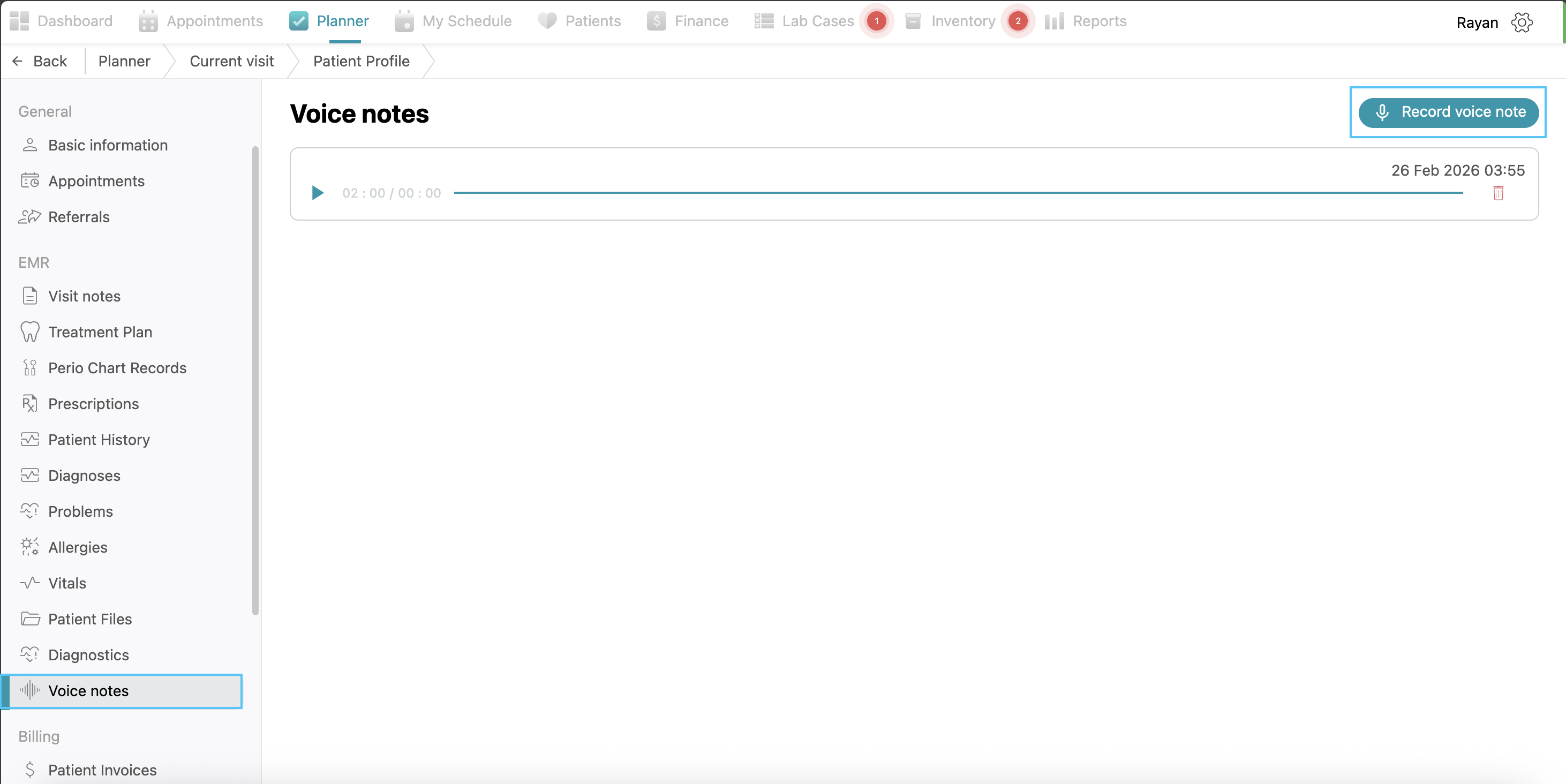
Voice Notes: Doctors can record and save audio notes regarding the patient’s case for hands-free documentation. Simply click “record voice note” button, record the note and click save.
2. By clicking on "Visit Notes," you will see the record of the visit notes that have been added, including who added them and their dates.
3. For prescriptions, you can write drugs for your patient by clicking on "Prescriptions." Click on the "Add Prescriptions" button, select the drug from the drug list, and then you can change the instructions. After that, click on the "Print and Lock" button to save and print it. You can see all of the prescriptions for this patient in this view.
4. If you want to add a file to this patient, such as an x-ray or before and after images or lab results, click on "Patient Files". Click on "Add More Files" or "Add Folder" and select the file you want to add and upload it. You can see all of the files added to this patient at any time in this view.
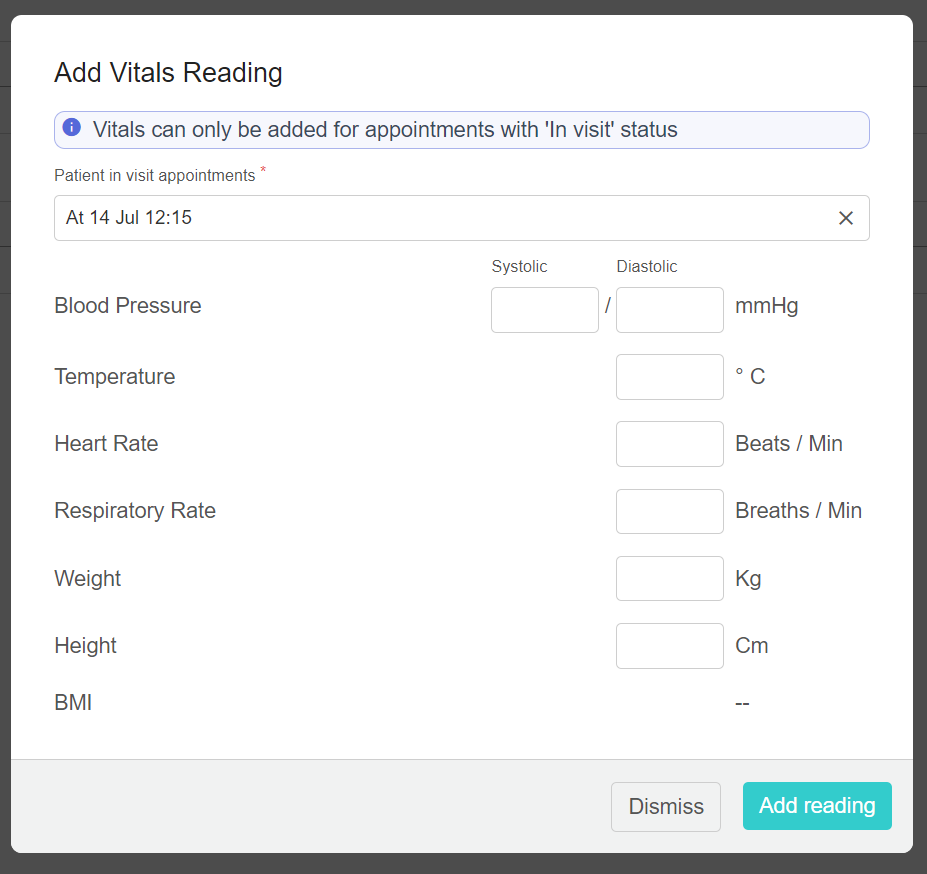
5. To add vitals to this patient, click on "Vitals" and then click on "Record Vital Readings." Fill it out and click on "Add Reading" after completing it. You can see all recorded vitals and dates in this view. Vitals can only be added for appointments with an “In Visit” status.
6. By clicking on "Generate Form," you can see all the forms in the system. Select the form you want to create and select the doctor's name from the doctor list. Click on "Generate Form" and then you will see a URL under the QR code to open the link in a new tab. The form automatically appears in the webform system on a tablet. Click on "Sign Form" to sign it if needed. You can see all forms generated for this patient in the patient reports on the patient profile.
7. In the visit notes, you must fill out medical data for every visit, including the duration of illness, chief complaint (C/O), and visit clinical notes.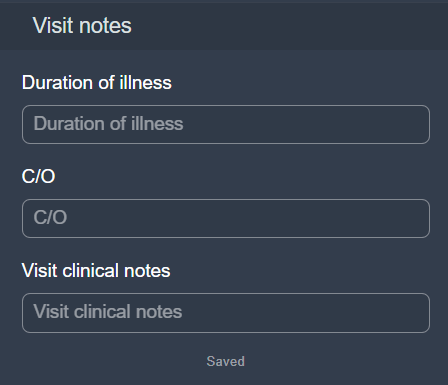
8. To add medical and dental history, click on the "Edit History" button. Once clicked, you can see the patient history with the latest edit. At the top are the medical alerts that are displayed as alerts - in red - above the dental chart. Then, add patient problems by clicking on the "Add Patient Problem" button, selecting patient problems and diagnoses from the diagnosis and problem list, and selecting the life cycle and onset date and resolution date. After completing it, click on the "Save" button to save it. You can add patient allergies by clicking on the "+ Patient Allergy" button, selecting allergy type from the allergy list and allergy from the allergy list, and then clicking on "Save." Fill out the medical history. You can see all previous patient problems and patient allergies that were added.
Note: The fields in the Medical History and Dental History Sections are fully customizable. You can use the default system questionnaire or request some changes to the form from the Customer Success team. The team will gather the desired questions and add them to your account.
9. You can add voice notes by clicking on the "Previous Voice Notes" button and clicking on the "Record Voice Note" button to record your voice.
Patient Reports
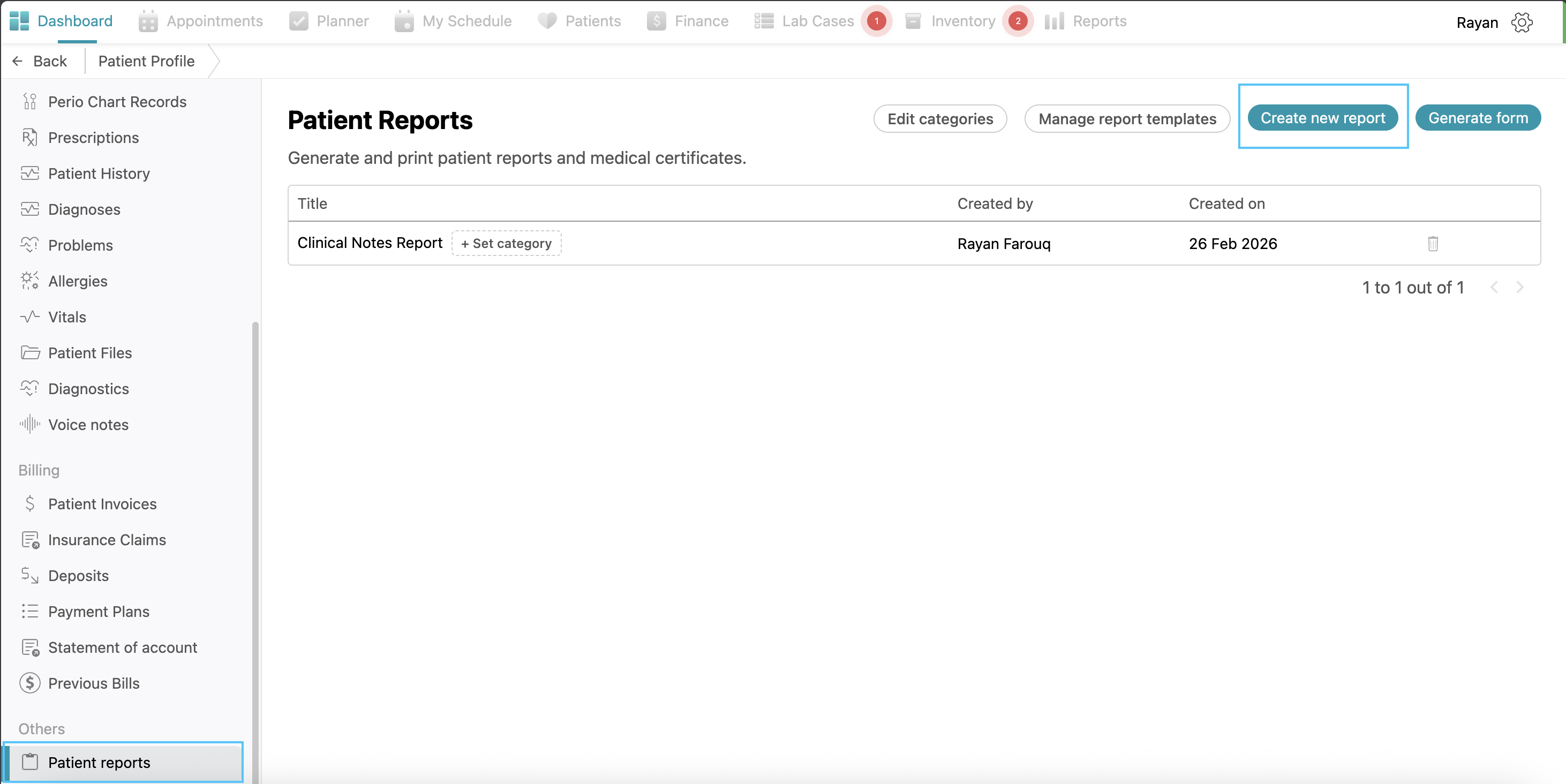
The Patient Reports tab provides a list of all patient’s forms like consent forms, insurance claims forms and also clinical reports generated for the patient. You can view the report title, the authoring doctor, and the creation date at a glance.
Generating patient report:
To create an official document based on existing clinical data, click the “Create new report” button at the top right of the page. Select “Clinical notes report” from the drop-down menu under predefined reports. The system will automatically generate a PDF report including the patient’s basic info, visit notes, and historical treatments, which can then be printed or downloaded.
If you want to create custom patient reports click the “Create new report” button and select “Empty report”. A pop-up box will appear from the right where you can:
-
Add a custom Title and use the text editor to write the content of the report.
-
Include additional data by checking boxes for specific treatment statuses (Current, Existing, Recommended, or Completed).
-
Select specific Custom Treatments and include Treatment Plan Notes, Visit Notes, or Patient History. Once you have selected the desired information, click the “Create report” button to finalize the document.
Generating Forms:
1. Generating clinical form
To prepare a document for patient signature, click the “Generate form” button and select “Clinic forms”. Choose a template, such as the “Consent Form,” and click “Generate form” Once the form is created, the patient can access it for signing by scanning a QR code with their phone that will appear automatically once you generate the form. After the patient submits their signature via their device, it is automatically added to the form. Alternatively, if your clinic utilizes a tablet, with an installed webform that’s integrated with Balsam Medico, the form will be sent to the tablet and ready to be signed by the patient. The patient will sign in the tablet and it’s done.
2. Generating Insurance Claim Form
To generate a report for insurance purposes, click the “Generate form” button and select “Insurance claims”. Choose the relevant insurance company from the list (e.g., NGI, NAS, Daman, etc.). A pop-up will allow you to select the specific Planned Treatments and Clinical Notes you wish to include in the claim. Finally, click “Generate form”.
Editing Reports Categories
If you want to edit categories, click on “edit categories” then write the category name, choose its color and click confirm then it will be added. (visualization: no need)
Managing Reports Templates
If you want to add a new report template, click on the “manage report templates” button, click on “+add report template” write the title of the report, then the content and click save. (visualization: no need)
If you want to schedule the next visit, simply click on the "Select Date" button at the top of the page and choose a date. After completing the treatment, click on the "Finish Visit" button.
